

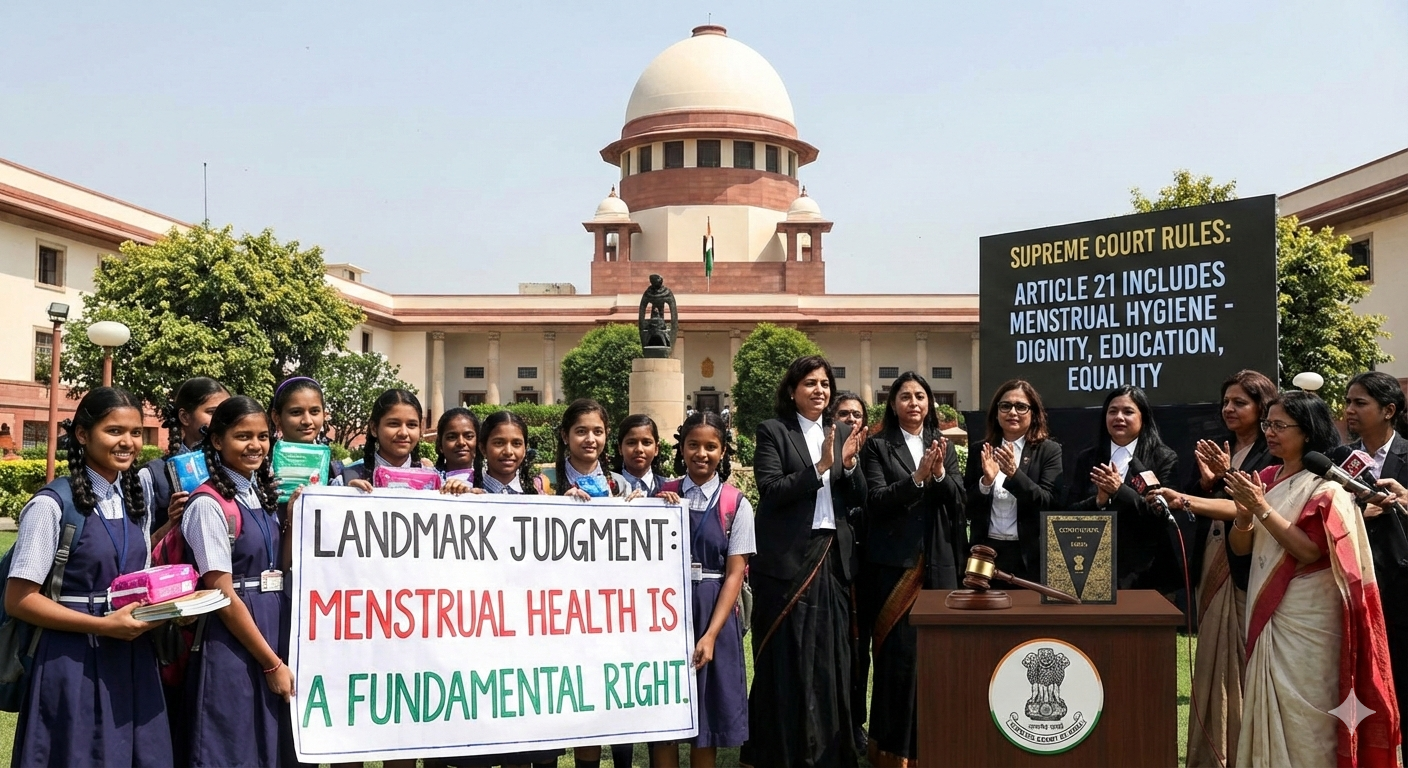
In a landmark judgment with far-reaching implications for women’s health and education, the Supreme Court of India has ruled that menstrual health is an essential component of the Right to Life under Article 21 of the Constitution. The decision firmly places menstrual hygiene management within the framework of fundamental rights, linking it directly to dignity, equality and access to education.
The apex court noted that inadequate access to menstrual hygiene products and sanitation facilities affects the health, privacy and confidence of girls and women, particularly in schools. Recognising menstruation as a public health and rights issue, the Court stressed that menstrual health in India can no longer be treated as a welfare measure but as a constitutional obligation.
Supreme Court Guidelines on Menstrual Hygiene
As part of its ruling, the Supreme Court issued clear directions to ensure implementation of menstrual health rights in schools across the country. The Court ordered authorities to:
- Provide free sanitary pads in schools to girls studying in middle and secondary classes
- Ensure availability of clean, functional and gender-segregated toilets, with water, soap and disposal systems
- Establish menstrual hygiene management support facilities, including emergency supplies like spare uniforms
- Monitor compliance regularly, particularly in rural and government-run schools
The judges observed that poor school sanitation facilities in India contribute to absenteeism and dropouts among adolescent girls, creating long-term barriers to education and equality. Such gaps, the Court held, amount to a violation of the fundamental rights of women and girls.
Article 21 and Women’s Dignity
Legal experts say the ruling significantly expands the scope of Article 21 Right to Life, reinforcing that health, dignity and bodily autonomy are inseparable from constitutional guarantees. By explicitly recognising menstrual health as a fundamental right, the Court has addressed a long-standing gap in public policy and legal interpretation.
Women’s rights advocates and public health specialists have welcomed the verdict, stating that it brings menstrual hygiene into the mainstream of women’s health rights in India. They emphasised that effective implementation will be crucial to translating the ruling into real-world impact.
Impact on Girls’ Education and Public Policy
The judgment is expected to influence education policy, state budgets and infrastructure planning, especially concerning girls’ education and dignity. By mandating improved access to sanitary products and hygiene facilities, the ruling aims to reduce stigma, promote attendance, and create a safer learning environment for young girls.
The Supreme Court’s decision also sets a strong precedent for addressing gender-specific health issues through a rights-based approach rather than short-term schemes.
By declaring menstrual health part of the Right to Life, the Court has reinforced the idea that dignity, health and equality are not privileges, but guaranteed rights under the Indian Constitution.

1 Comment
Pingback: Women in Logistics: How the Industry Is Redefining Roles