

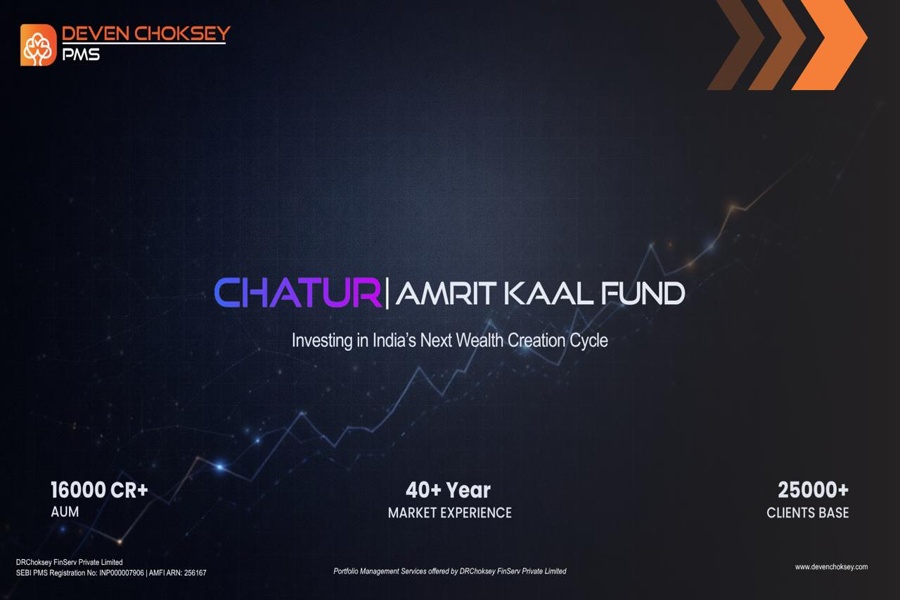
DRChoksey FinServ Private Limited, led by market veteran Deven Choksey, has introduced a new Portfolio Management Service (PMS) strategy titled “Chatur Amrit Kaal Fund”, aimed at aligning investments with India’s long-term structural growth trends and economic transformation.
The launch comes at a time when India is increasingly being positioned as one of the fastest-growing major economies in the world, with strong macroeconomic indicators and policy-led growth initiatives creating long-term investment opportunities.
With India entering what many analysts describe as an economic inflection point, the new fund seeks to capitalise on multi-decade themes including consumption growth, manufacturing expansion, financialisation of household savings, digital platform businesses, and the energy transition.
This new PMS offering reflects a strategic approach to investing in businesses that are expected to benefit from India’s evolving economic landscape over the coming decades.
India’s Structural Growth Story
India’s economic momentum continues to remain robust.
According to recent estimates, India’s nominal GDP is projected at approximately $3.96 trillion in FY25, while real GDP growth is expected to sustain at around 6–7 percent annually, reinforcing its position among the world’s leading growth economies.
At the same time, the country is witnessing accelerated digital adoption and infrastructure development.
For instance, UPI transactions have crossed 26 billion per month, underlining the scale and speed of India’s digital transformation. Simultaneously, government-led capital expenditure and infrastructure investments are catalysing broader economic activity across sectors.
These developments are increasingly being seen not as short-term cyclical trends but as part of deep structural shifts in the Indian economy.
Against this backdrop, DRChoksey FinServ’s Chatur Amrit Kaal Fund aims to align investor portfolios with these long-duration growth drivers.
The phrase “Amrit Kaal”, now widely associated with India’s long-term development vision, reflects a strategic period of economic evolution marked by reforms, rising domestic demand, digital expansion, and policy-led industrialisation.
Also read: https://circleofnews.in/yash-a-agarwal-joins-deven-choksey-group/
Chatur Amrit Kaal Fund: Built Around Structural Economic Themes
According to the firm, the fund strategy is designed to identify and invest in businesses that are likely to benefit from India’s structural transformation over the next several decades.
The investment framework is organised around five core long-term themes:
1. Consumption-led growth
India’s consumption story continues to remain one of the strongest pillars of its economic expansion.
Rising disposable incomes, rapid urbanisation, increasing formalisation of the economy, and aspirational spending patterns are expected to drive sustained growth in consumer-focused businesses.
This includes sectors linked to:
- Consumer goods
- Retail
- Healthcare
- Lifestyle and discretionary spending
- Rural demand expansion
As India’s middle class continues to expand, the consumption theme is expected to remain a key investment driver.
2. Manufacturing and infrastructure expansion
The second core pillar focuses on manufacturing and infrastructure growth, which is being supported by policy measures such as Production Linked Incentive (PLI) schemes, Make in India initiatives, and rising government capital expenditure.
India’s manufacturing ambitions are increasingly attracting both domestic and global investments across sectors such as:
- Electronics
- Defence
- Capital goods
- Industrial machinery
- Logistics and infrastructure
The ongoing capex-led growth cycle is expected to support companies involved in industrial expansion, construction, engineering, and supply chain ecosystems.
3. Financialisation of savings
A major shift underway in India is the financialisation of household savings.
Traditionally, Indian savings have been concentrated in physical assets such as gold and real estate. However, there has been a visible move towards financial assets including:
- Equities
- Mutual funds
- PMS products
- Insurance
- SIP-based investments
This trend has been supported by growing retail investor participation, improved financial awareness, and easier access through digital investment platforms.
The fund seeks to tap opportunities emerging from this structural migration of savings into formal financial markets.
4. Digital platforms and technology-led businesses
India’s digital economy continues to scale rapidly.
The growth of digital payments, rising internet penetration, data consumption, and platform-led business models is creating significant opportunities across sectors.
This theme includes businesses operating in:
- Fintech
- Digital payments
- E-commerce
- SaaS and enterprise technology
- Platform ecosystems
- Data infrastructure
The continued expansion of India’s digital economy is widely viewed as a long-term secular growth driver.
5. Energy transition and clean technology
The fifth pillar focuses on energy transition, an increasingly important investment theme globally and in India.
The country’s push toward renewable energy, electric mobility, clean technologies, and power infrastructure modernisation is creating long-term opportunities.
This includes sectors such as:
- Solar and wind energy
- Power transmission
- Grid modernisation
- Battery technologies
- Clean energy equipment
The firm noted that this theme aligns with both domestic policy priorities and global sustainability trends.
Investment approach and portfolio construction framework
The Chatur Amrit Kaal Fund follows a disciplined and structured investment approach designed around long-term value creation.
According to the company, the portfolio construction process focuses on:
Businesses aligned with long-term growth drivers
The fund aims to identify companies that are strategically positioned to benefit from India’s structural economic shifts.
Capital efficiency and return metrics
A key parameter in stock selection includes evaluation of return on capital employed (ROCE) and capital allocation efficiency.
Balance sheet strength
Companies with sustainable leverage profiles, healthy cash flows, and resilient balance sheets are prioritised.
Governance and management quality
Corporate governance standards, promoter credibility, and management execution capabilities remain central to the investment framework.
Long-term investment horizon
The strategy is designed for investors seeking exposure to long-duration themes with a disciplined portfolio review process.
This approach is intended to combine structural growth investing with prudent risk management.
Managed by Vaishali Pitale Having Two Decades of Experience
The strategy is being managed by Vaishali Pitale, who brings more than 20 years of experience in capital markets and investment management.
Her experience across market cycles is expected to support the fund’s long-term thematic investing approach.
In an increasingly dynamic market environment, portfolio strategies with experienced management teams and strong investment frameworks are gaining traction among investors seeking differentiated wealth creation opportunities.
Changing Investment Landscape in India
Market participants note that investment strategies in India are increasingly moving toward long-duration thematic opportunities rather than purely cyclical market plays.
As India’s economic structure evolves, investors are showing stronger interest in themes linked to:
- Domestic consumption
- Policy-led manufacturing
- Financial sector deepening
- Technology adoption
- Clean energy
This shift is also visible in the broader capital markets ecosystem.
Retail participation in Indian financial markets has grown significantly in recent years.
For instance, participation in equity derivatives markets has expanded sharply, with the number of individual traders increasing from approximately 7 lakh to over 90 lakh in FY25, according to industry and regulatory observations.
This growing market participation highlights rising financial awareness and increased investor appetite for market-linked instruments.
However, market experts continue to emphasise the importance of structured investment frameworks, risk management, and long-term asset allocation strategies.
India’s Long-term Economic Outlook
India’s medium- to long-term growth outlook continues to be supported by several structural factors.
These include:
Sustained infrastructure spending
Public and private sector investments in roads, railways, urban development, and logistics continue to support growth.
Increasing digital penetration
Rapid adoption of digital payments, internet services, and technology-led platforms is reshaping the economy.
Expansion of formal financial systems
A growing share of savings is moving into organised financial products.
Policy-led manufacturing initiatives
Government-led industrial policies continue to support capacity creation and investment.
Together, these trends are expected to play a defining role in shaping investment opportunities in India over the coming years.
That said, analysts note that market outcomes will continue to be influenced by:
- Global macroeconomic conditions
- Interest rate cycles
- Commodity prices
- Domestic policy changes
- Geopolitical developments
Disclaimer
Portfolio Management Services are subject to market risks. Please read all related documents carefully before investing. Past performance is not indicative of future results.
