

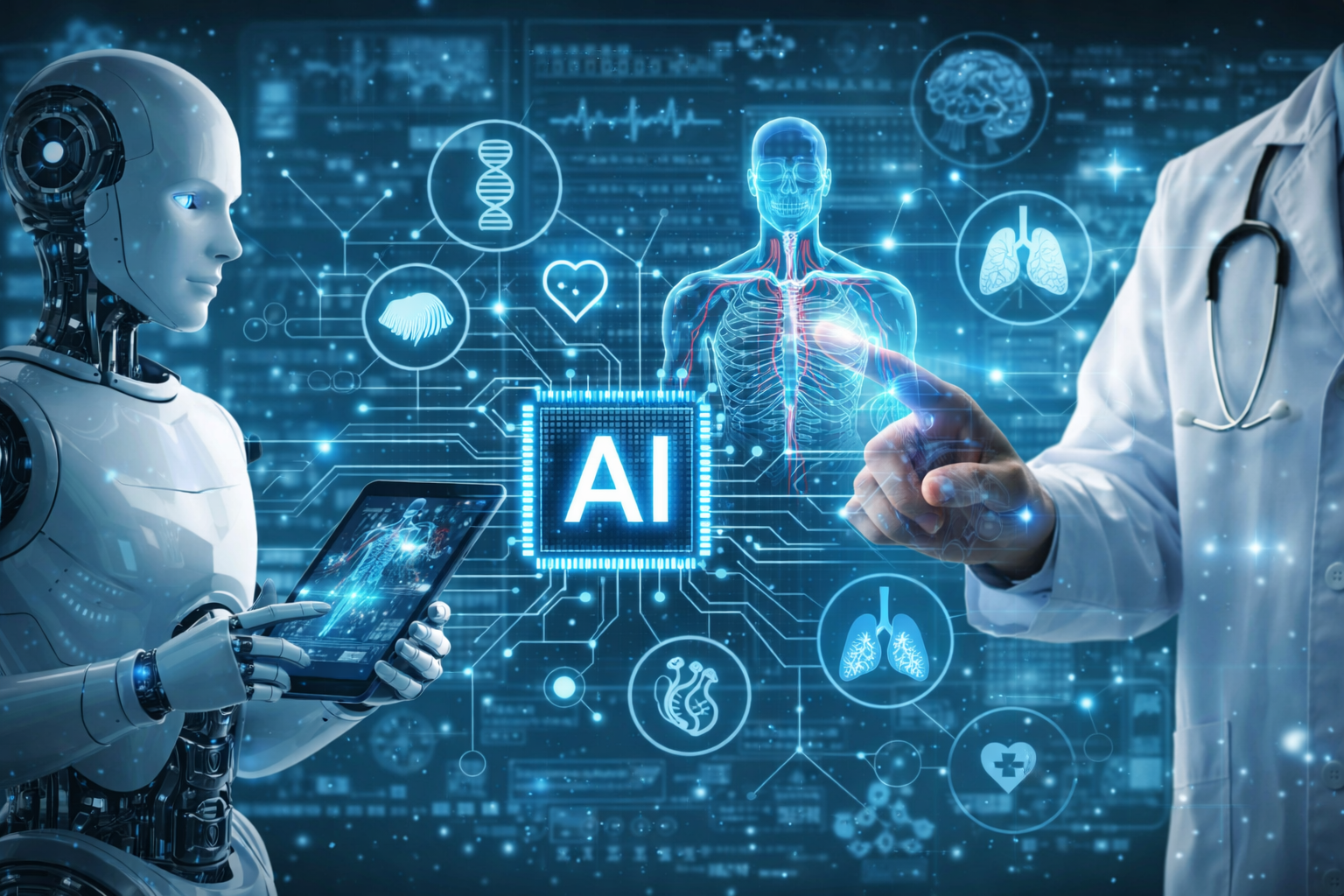
Artificial Intelligence is rapidly transforming healthcare systems across the world, and India is emerging as one of the fastest adopters of this technology. From AI-powered diagnostics to predictive healthcare analytics, hospitals and medical institutions are using Artificial Intelligence to improve accuracy, efficiency, and accessibility in healthcare services.
In simple terms, Artificial Intelligence in healthcare refers to the use of machine learning algorithms, data analysis systems, and automated technologies that assist doctors in diagnosing diseases, predicting medical risks, and managing patient care.
In India, where healthcare infrastructure faces challenges such as doctor shortages and uneven access to medical facilities, Artificial Intelligence is helping bridge critical gaps.
What Is Artificial Intelligence in Healthcare?
Artificial Intelligence in healthcare refers to computer systems that analyze medical data, learn patterns from patient information, and assist healthcare professionals in clinical decision-making.
These technologies rely on machine learning, deep learning, and data-driven algorithms to interpret complex medical information.
Key functions of Artificial Intelligence in healthcare include:
- AI medical diagnostics
- Predictive healthcare analytics
- Medical imaging analysis
- Clinical decision support systems
- Hospital workflow automation
These tools do not replace doctors but act as intelligent assistants that help medical professionals make faster and more accurate decisions.
Why Artificial Intelligence Is Important for India’s Healthcare System
India faces several structural challenges in healthcare delivery, including:
- Limited doctor-to-patient ratios
- Uneven healthcare infrastructure in rural areas
- High patient volumes in urban hospitals
- Delays in diagnosis and treatment
By integrating Artificial Intelligence in healthcare, medical institutions can improve efficiency and reduce pressure on healthcare workers.
For example, AI healthcare platforms can analyze patient symptoms, medical history, and diagnostic reports in seconds. This enables faster identification of diseases and helps doctors prioritize critical cases.
As healthcare demand continues to grow, Artificial Intelligence is becoming an essential tool for improving patient outcomes in India.
How Artificial Intelligence Is Improving Medical Diagnosis
One of the most important uses of Artificial Intelligence in healthcare is AI-powered diagnostics.
AI systems can analyze medical images such as:
- X-rays
- CT scans
- MRI scans
- pathology slides
Using machine learning algorithms, these systems can detect abnormalities that might be difficult for the human eye to identify.
In India, hospitals are using AI medical imaging technology to diagnose diseases such as:
- tuberculosis
- breast cancer
- diabetic retinopathy
- cardiovascular diseases
Early detection significantly improves survival rates and treatment outcomes.
For example, AI tools analyzing chest X-rays can identify signs of tuberculosis within seconds, helping doctors diagnose the disease earlier and begin treatment faster.
Artificial Intelligence and Telemedicine in India
Another major area where Artificial Intelligence is transforming healthcare is telemedicine.
India’s rural regions often lack access to specialist doctors. AI-powered telemedicine platforms allow patients to receive medical guidance remotely through digital platforms.
These systems combine AI symptom analysis, remote consultations, and digital health records to deliver medical services even in underserved areas.
Patients can enter symptoms into AI-powered health applications, which then analyze the information and recommend whether the patient should consult a doctor immediately.
This approach helps:
- Expand healthcare access
- Reduce travel for patients
- Improve early disease detection
Telemedicine powered by Artificial Intelligence is expected to play a major role in India’s digital health transformation.
Predictive Healthcare Analytics Using Artificial Intelligence
One of the most promising applications of Artificial Intelligence is predictive healthcare analytics.
AI systems can analyze large datasets including:
- patient medical records
- lifestyle factors
- genetic data
- environmental health patterns
Using this data, predictive analytics algorithms can identify individuals who may be at risk of developing chronic diseases.
For example, AI healthcare models can predict the likelihood of conditions such as:
- diabetes
- heart disease
- hypertension
- respiratory illnesses
Doctors can then intervene early with preventive treatment and lifestyle recommendations.
This shift from reactive treatment to preventive healthcare is one of the biggest benefits of Artificial Intelligence in medicine.
Artificial Intelligence in Drug Discovery and Medical Research
Artificial Intelligence is also transforming pharmaceutical research and drug development.
Traditional drug discovery can take more than a decade and cost billions of dollars. However, AI-driven drug discovery platforms can analyze chemical compounds and biological data much faster.
Using AI research models, scientists can identify promising drug candidates and simulate their effects before conducting laboratory tests.
Several Indian healthtech startups and biotechnology firms are now using Artificial Intelligence for pharmaceutical innovation.
This technology could accelerate the development of treatments for diseases such as cancer, infectious diseases, and neurological disorders.
Artificial Intelligence in Hospital Operations
Beyond clinical diagnosis, Artificial Intelligence is improving hospital management and administrative efficiency.
Hospitals generate enormous amounts of patient data daily. Managing this information efficiently is critical for delivering quality care.
AI hospital management systems help automate several operational tasks, including:
- appointment scheduling
- electronic health records management
- billing and claims processing
- patient admission forecasting
By reducing administrative workload, healthcare professionals can focus more on patient care rather than paperwork.
Challenges of Artificial Intelligence in Healthcare
Despite the potential benefits, implementing Artificial Intelligence in healthcare comes with several challenges.
One of the biggest concerns is data privacy and security. Medical data is highly sensitive, and healthcare institutions must ensure that AI systems comply with strict data protection standards.
Another challenge is the availability of high-quality medical datasets needed to train AI models accurately.
There are also concerns about algorithm bias, which can occur if training data does not represent diverse populations.
Experts emphasize that Artificial Intelligence should support doctors, not replace them. Human clinical expertise remains essential for interpreting AI insights and making final treatment decisions.
The Future of Artificial Intelligence in Indian Healthcare
The future of Artificial Intelligence in healthcare in India looks highly promising.
Government initiatives promoting digital health infrastructure, the rise of AI healthcare startups, and increasing investments in health technology innovation are accelerating adoption.
Experts believe that Artificial Intelligence could help India achieve:
- faster medical diagnoses
- improved patient outcomes
- lower healthcare costs
- wider access to healthcare services
As medical data continues to grow and AI technology evolves, Artificial Intelligence will likely become a central pillar of modern healthcare systems.
Conclusion
Artificial Intelligence is redefining how healthcare is delivered in India. From AI-powered diagnostics and predictive healthcare analytics to telemedicine platforms and hospital automation, the technology is reshaping the medical ecosystem.
While challenges such as data security and ethical use must be addressed, the potential benefits of Artificial Intelligence in healthcare are enormous.
As India continues its digital transformation, Artificial Intelligence could play a key role in building a smarter, more accessible, and more efficient healthcare system for millions of people.
#ArtificialIntelligence #India #telemedicineplatforms #

2 Comments
Pingback: Indian Startup Ecosystem in 2026: How Innovation, AI, and Deep Tech Are Redefining the Future - Circle of News
Pingback: IndiaAI Mission: How India Is Building a Global AI Powerhouse