

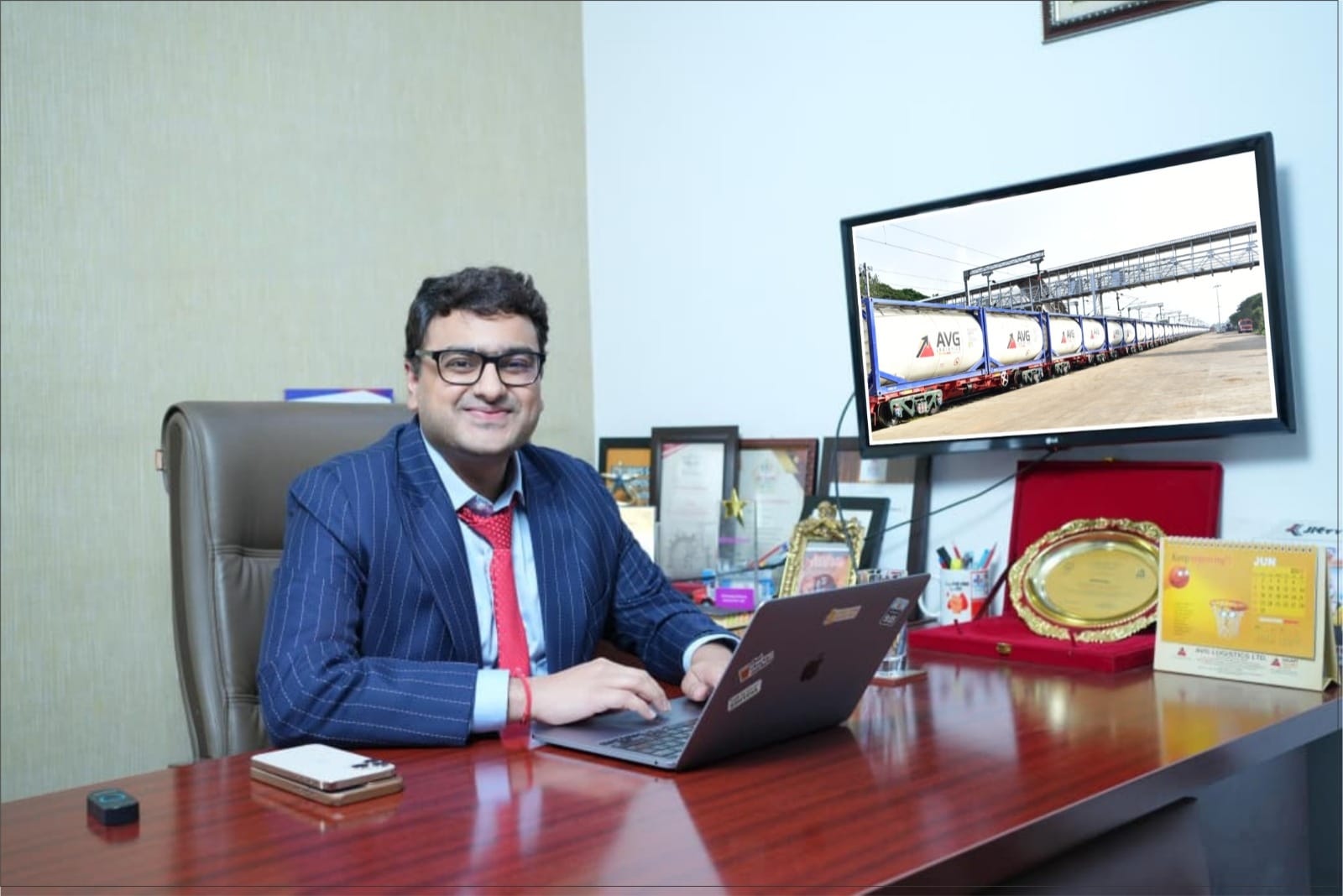
With India’s chemical and industrial sectors expanding steadily, logistics providers are being called upon to deliver transportation solutions that are not only scalable but also compliant, safe, and environmentally responsible. AVG Logistics Limited has responded to this demand by entering the liquid logistics segment, introducing a rail-based bulk liquid transportation model focused on chemical cargo.
According to Vinayak Gupta, Chief Strategy Officer & ESG Head, AVG Logistics Limited, the decision reflects both market demand and a long-term view of how industrial supply chains are evolving in India.
The move into liquid logistics, he explains, is driven by increasing expectations from chemical and industrial clients for logistics partners who can handle sensitive cargo with global safety standards and consistent delivery performance. Conventional road-based transportation, while widely used, often presents challenges related to risk exposure, cost efficiency, transit delays, and environmental impact. A rail-integrated model helps address these concerns while strengthening AVG Logistics’ multimodal capabilities.
The growing importance of liquid logistics, particularly chemical logistics, is closely tied to the role the chemical sector plays across pharmaceuticals, agriculture, manufacturing, hydrocarbons, and consumer goods. As production scales and supply chains become more complex, the movement of liquid chemicals demands specialised infrastructure, trained handling, and strict regulatory compliance.
Gupta notes that liquid logistics is no longer a niche service. It has become a core requirement for industrial supply chains, driven by the need to transport bulk volumes efficiently, minimise transit losses, and comply with domestic and international safety norms. This shift has significantly increased demand for ISO tank containers, rail-based solutions, and integrated logistics models.
Rail-led liquid logistics also aligns with AVG Logistics’ broader growth strategy. Rail transportation allows large volumes of liquid cargo to be moved in a single run, delivering cost efficiency and operational consistency. From a business perspective, this vertical supports revenue diversification and long-term scalability.
As part of its initial rollout, AVG Logistics has introduced 96 ISO tank containers with a combined carrying capacity of approximately 3,100 tonnes per trip. The company estimates that this deployment alone has the potential to generate annual revenue of Rs. 22–24 crore, reflecting strong demand for rail-based liquid logistics solutions.
By combining rail movement with first- and last-mile road connectivity, AVG Logistics is building an end-to-end logistics offering that strengthens its positioning across key industrial corridors.
Safety and compliance remain central to the company’s liquid logistics framework. Rail transportation inherently reduces the number of handling points, lowering the risk of spillage and accidents when compared to road-only movement—an important consideration for chemical cargo.
Gupta emphasises that AVG Logistics follows stringent operational protocols, uses certified ISO tank containers, and ensures adherence to all applicable environmental and regulatory standards. Continuous monitoring and coordination with regulatory authorities further reinforce the company’s commitment to safe and compliant transportation.
The newly manufactured ISO tanks are built in line with globally accepted safety and quality standards. They are equipped with real-time GPS tracking systems for continuous monitoring and feature an H-shaped end-to-end walking path along the train rake, extending up to two kilometres. This design enhances operational safety, improves usability, and allows secure inspection and emergency access when required.
Technology, Gupta adds, is becoming an increasingly important differentiator in liquid logistics, particularly for sensitive cargo such as chemicals. Customers now expect real-time visibility, transparency, and data-driven insights across their supply chains.
While large-scale adoption of advanced technologies such as IoT, predictive analytics, and automation is still evolving in India, AVG Logistics is progressively integrating technology and AI-driven systems to enhance tracking, risk management, and operational efficiency. The ISO tank containers are fitted with high-precision built-in gauges to continuously monitor parameters such as pressure and temperature, ensuring cargo integrity and minimising operational risks.
Looking ahead, liquid logistics is expected to remain a long-term growth driver for both AVG Logistics and the broader logistics sector. Rising industrial output, expanding domestic and export-oriented chemical markets, and an increased focus on sustainability are likely to accelerate demand for specialised liquid transportation solutions.
AVG Logistics plans to scale this vertical in line with customer demand, infrastructure readiness, and corridor viability. The company is also exploring opportunities to support export-driven chemical supply chains through integrated multimodal logistics offerings.
In line with its long-term vision, the organisation plans to significantly expand its liquid logistics capacity by growing its fleet to up to 500 ISO tank containers in the coming years—strengthening its ability to serve complex and high-value cargo requirements.
Closing Perspective
AVG Logistics’ entry into liquid logistics represents a strategic response to the evolving needs of India’s industrial ecosystem. With a focus on rail-led transportation, safety-first operations, technology integration, and scalable infrastructure, the company is positioning itself to play a meaningful role in shaping the future of chemical and liquid logistics in India.

1 Comment
Pingback: AVG Logistics Launches Rail-Based Liquid Logistics to Strengthen Safe Chemical Transportation - Circle of News