

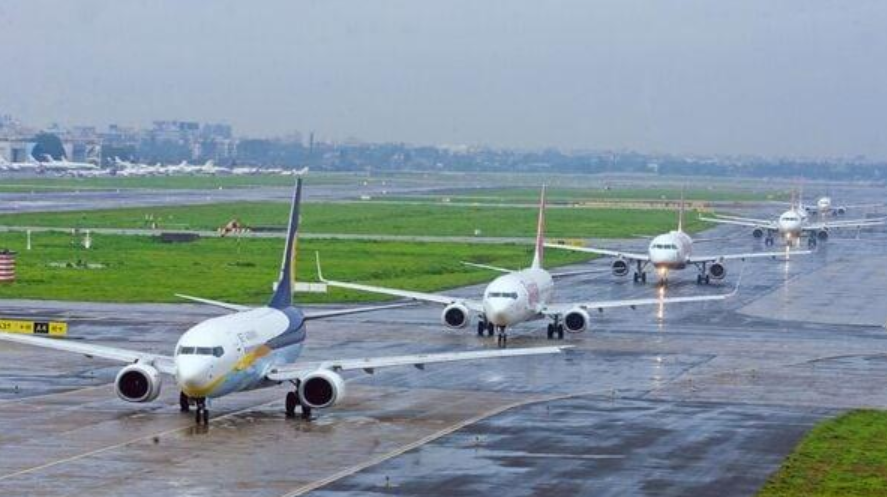
India’s aviation sector is flying into a new growth phase in FY 2025–26, with passenger traffic not only recovering from pandemic lows but surpassing previous records. Driven by rising domestic demand, expanding airline networks, and aggressive infrastructure development, the country’s busiest airports are handling unprecedented volumes—while also facing capacity and operational challenges.
Delhi Leads, But the Gap Is Strategic
Indira Gandhi International Airport, Delhi, continues to dominate as India’s busiest airport, maintaining a significant lead over its peers. Its strength lies not just in scale, but in its dual role as the country’s largest domestic hub and primary international gateway.
Mumbai’s Chhatrapati Shivaji Maharaj International Airport holds second place, despite operating under severe capacity constraints. Limited room for expansion has capped its growth, even as demand remains consistently high.
In contrast, Kempegowda International Airport, Bengaluru, has emerged as a strong third contender, benefiting from infrastructure upgrades such as Terminal 2 and the city’s thriving tech-driven travel demand.
Insight: The top three airports reflect three different realities: Delhi’s scalability, Mumbai’s saturation, and Bengaluru’s expansion-led rise.
Top 10 Busiest Airports in India (FY 2025–26)
Based on the latest traffic trends and recent annual data, India’s top airports by passenger footfall are:
- Indira Gandhi International Airport, Delhi
- Chhatrapati Shivaji Maharaj International Airport, Mumbai
- Kempegowda International Airport, Bengaluru
- Rajiv Gandhi International Airport, Hyderabad
- Chennai International Airport, Chennai
- Netaji Subhas Chandra Bose International Airport, Kolkata
- Sardar Vallabhbhai Patel International Airport, Ahmedabad
- Cochin International Airport, Kochi
- Pune International Airport, Pune
- Lokpriya Gopinath Bordoloi International Airport, Guwahati
While the top six positions remain largely unchanged, the real competition is intensifying among mid-tier airports.
Domestic Travel Continues to Drive Growth
A defining feature of India’s aviation boom is the overwhelming dominance of domestic travel, which accounts for nearly 80 to 85 percent of total passenger traffic.
Metro airports such as Delhi and Mumbai still lead in international volumes, but even they rely heavily on domestic routes for overall traffic. Meanwhile, airports like Pune and Guwahati remain almost entirely dependent on domestic passengers.
Insight: Unlike global aviation hubs, India’s growth story is still firmly domestic first, making it more resilient to global travel disruptions.
Airline Networks Are Reshaping Airport Rankings
Airport traffic is increasingly being shaped by airline strategies rather than just city size or geography.
- IndiGo continues to dominate domestic skies, driving high volumes at Delhi, Bengaluru, and Hyderabad.
- Air India is expanding aggressively in international markets, strengthening long-haul traffic at key metro airports.
- Akasa Air is adding competitive capacity on metro to tier 2 routes, boosting regional connectivity.
Insight: Airports that become airline hubs tend to grow faster, even if the city itself is smaller.
Infrastructure: The Deciding Factor for Future Growth
A widening gap is emerging between airports that can expand and those that cannot.
Delhi is investing heavily in new runways and terminal capacity, positioning itself to handle over 100 million passengers annually in the near future. Bengaluru and Hyderabad are also scaling up rapidly with modern terminals and better passenger handling systems.
Mumbai, on the other hand, remains constrained due to space limitations, forcing reliance on the upcoming Navi Mumbai airport to ease pressure.
Insight: Future rankings may depend less on demand and more on which airports can physically accommodate growth.
Tier 2 Cities Are No Longer Secondary
A notable shift in FY 2025–26 is the rise of tier 2 airports as independent traffic hubs rather than mere feeders.
Ahmedabad is seeing strong growth due to business travel and international diaspora movement. Kochi continues to benefit from Gulf connectivity, while Guwahati is solidifying its position as the gateway to Northeast India.
Insight: India’s aviation growth is becoming more decentralised, reducing overdependence on metro cities.
Passenger Experience Is Becoming a Differentiator
Airports are increasingly competing on efficiency and experience rather than just scale.
Initiatives like Digi Yatra, biometric boarding, and contactless processing are reducing wait times at major airports. Enhanced retail, lounges, and seamless transfers are also boosting non-aeronautical revenues.
Insight: Passenger experience is emerging as a key metric in defining airport competitiveness.
Cargo Traffic Adds Stability
Beyond passenger numbers, cargo is playing a crucial supporting role in airport growth.
Delhi, Mumbai, and Hyderabad are leading cargo hubs, benefiting from growth in e-commerce, pharmaceuticals, and high-value exports. Investments in dedicated cargo terminals are helping airports diversify revenue streams.
Insight: Airports with strong cargo operations are better insulated from fluctuations in passenger demand.
Government Push Is Reshaping Connectivity
The government’s regional connectivity push under UDAN is altering traditional traffic patterns.
Smaller cities are now directly connected, reducing the need for passengers to transit through major hubs. Airports like Guwahati and Pune are seeing increased traction as a result.
Insight: While metro airports will remain dominant, regional airports will steadily capture a larger share of traffic.
Privatisation Is Driving Efficiency
Private sector participation is transforming airport infrastructure and operations.
Operators like GMR Group and Adani Group are investing in modernisation, digital systems, and capacity expansion, setting new benchmarks for efficiency.
Insight: Privately managed airports are leading the shift towards globally competitive aviation infrastructure in India.
Also Read: JSW Motors Partners with Dassault Systèmes
Outlook: Stable Leaders, Shifting Middle Order
India’s aviation market is on track to become one of the fastest-growing globally, with passenger numbers expected to double over the next decade.
While Delhi, Mumbai, and Bengaluru are likely to retain their top positions, the real movement will occur in the mid-tier rankings. Upcoming infrastructure projects such as Noida International Airport and Navi Mumbai Airport could significantly reshape traffic distribution.
