

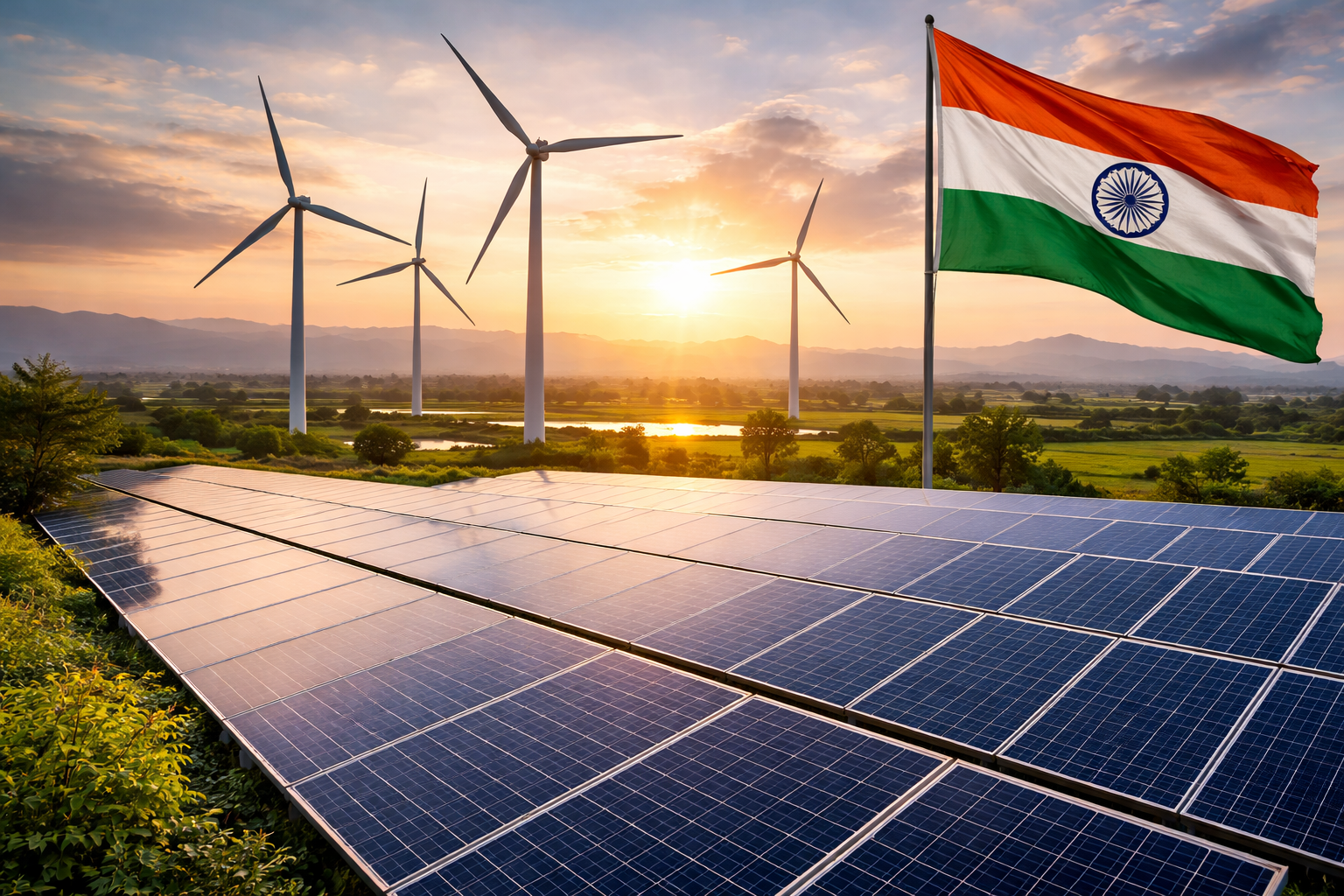
India has officially emerged as the world’s third-largest country in renewable energy installed capacity, overtaking Brazil and moving behind only China and the United States.
The milestone marks a major moment in the country’s clean energy journey and reinforces India’s growing position as one of the most important renewable energy markets in the world. According to the latest figures based on International Renewable Energy Agency (IRENA) statistics, India’s installed renewable energy capacity has reached 250.52 GW, placing it ahead of Brazil’s 228.20 GW.
For India, this is not just a ranking update.
It is a strategic economic, climate, and infrastructure milestone that reflects how rapidly the country is scaling its solar, wind, hydro, and non-fossil energy ecosystem.
India Now Ranks Behind Only China and the US
As per the latest global ranking, the renewable energy capacity standings are:
- China: 2,258.02 GW
- United States: 467.92 GW
- India: 250.52 GW
- Brazil: 228.20 GW
- Germany: 199.92 GW
This puts India firmly among the world’s leading clean energy economies.
The scale of this achievement becomes even more significant when viewed in the context of India’s energy demand growth.
India is one of the fastest-growing major economies in the world, and its electricity demand continues to rise across residential, industrial, mobility, and digital infrastructure sectors.
Meeting this growth through renewables is strategically critical.
A Record Year for Renewable Capacity Addition
One of the biggest reasons behind this jump is India’s record addition of 55.3 GW of non-fossil fuel capacity in FY 2025–26.
This is the highest annual increase the country has ever recorded. This capacity addition includes strong momentum in:
- solar power
- wind energy
- large hydro
- bioenergy
- nuclear support
The scale of this addition is particularly important because it reflects acceleration rather than incremental growth. India is no longer adding renewable capacity slowly. It is scaling at a globally competitive pace.
Solar Remains the Biggest Growth Engine!
The strongest contributor to this milestone continues to be solar power.
India’s total installed solar capacity has now reached approximately 150.26 GW, making it the single largest component of the renewable mix.
Solar’s rise has been driven by multiple structural factors:
- utility-scale solar parks
- rooftop solar adoption
- commercial solar installations
- falling equipment costs
- stronger policy incentives
Rooftop solar has especially gained traction in urban and industrial areas. This trend is expected to continue as electricity costs rise and businesses focus more on sustainability goals.
Wind Energy is Also Accelerating
Wind has also played a major role in India’s rise. The country added a record 6.05 GW of wind capacity in FY26, a 46% year-on-year increase. Total installed wind power capacity now stands at 56.09 GW.
This is especially important for states such as:
- Gujarat
- Tamil Nadu
- Karnataka
- Maharashtra
- Rajasthan
Wind and solar together are becoming the backbone of India’s renewable transition.
India Crossed a Major Paris Agreement Milestone Early
One of the most important indicators of India’s progress is that the country achieved 50% cumulative installed power capacity from non-fossil sources in June 2025, five years ahead of its 2030 Paris Agreement target.
This is a major climate policy achievement. It signals that India is not just making long-term commitments but is also delivering on them ahead of schedule.
This strengthens India’s credibility in global climate discussions.
Why This Matters for India’s Economy?
This is not only an environmental story. It is also a major economic story. Renewable energy growth supports:
- manufacturing
- infrastructure investment
- employment
- transmission upgrades
- storage technologies
- battery ecosystems
Every gigawatt added creates demand across multiple sectors.
This includes:
- engineering
- EPC firms
- logistics
- land development
- power electronics
- grid technology
The multiplier effect is significant.
Energy Security Becomes Stronger
Another major reason this milestone matters is energy security. India remains one of the world’s largest importers of fossil fuels, especially crude oil and natural gas. Increasing domestic renewable generation reduces dependence on imported energy.
This helps improve:
- current account stability
- currency resilience
- inflation management
- energy pricing risk
At a time of global geopolitical volatility, this becomes strategically important.
The AI and Data Centre Connection
This story is also highly relevant to the AI and digital infrastructure sector. India’s data centre ecosystem is growing rapidly due to:
- AI adoption
- cloud expansion
- digital payments
- enterprise computing
These facilities require significant electricity. Renewable energy is increasingly becoming the preferred power source for large-scale data centres and AI infrastructure. As AI demand rises, clean power becomes even more important.
This gives the renewable sector an added future growth layer.
Why This Matters for Global Investors?
Global investors are closely watching India’s renewable energy story. The sector continues to attract:
- sovereign wealth funds
- infrastructure funds
- pension funds
- climate-focused investors
- global utilities
India’s scale, policy clarity, and long-term demand profile make it one of the most investable renewable markets globally. This ranking milestone reinforces that narrative.
India’s 2030 Target: The Next Big Number
The next major target remains 500 GW of non-fossil installed capacity by 2030. This means India still has a significant expansion runway. The pace of additions over the next 4 years will be critical.
Key sectors to watch include:
- grid-scale storage
- battery manufacturing
- transmission infrastructure
- green hydrogen
- hybrid solar-wind projects
What Challenges Remain?
Despite the milestone, several challenges remain. These include:
1) Grid infrastructure
Transmission upgrades are essential for balancing variable renewable supply.
2) Storage
Battery storage remains critical for reliability and night-time supply.
3) Land acquisition
Large projects often face land-related delays.
4) Financing
Long-term low-cost debt remains necessary for sustained expansion.
These factors will determine how quickly India reaches the 500 GW target.
Final thoughts
India becoming the world’s third-largest renewable energy market is one of the most important infrastructure and climate milestones of 2026. It reflects rapid capacity growth, stronger energy security, and rising global relevance in the clean energy transition.
More importantly, it positions India as one of the key countries shaping the global energy future. The next few years will determine whether it can close the gap with the US and move even higher.
