

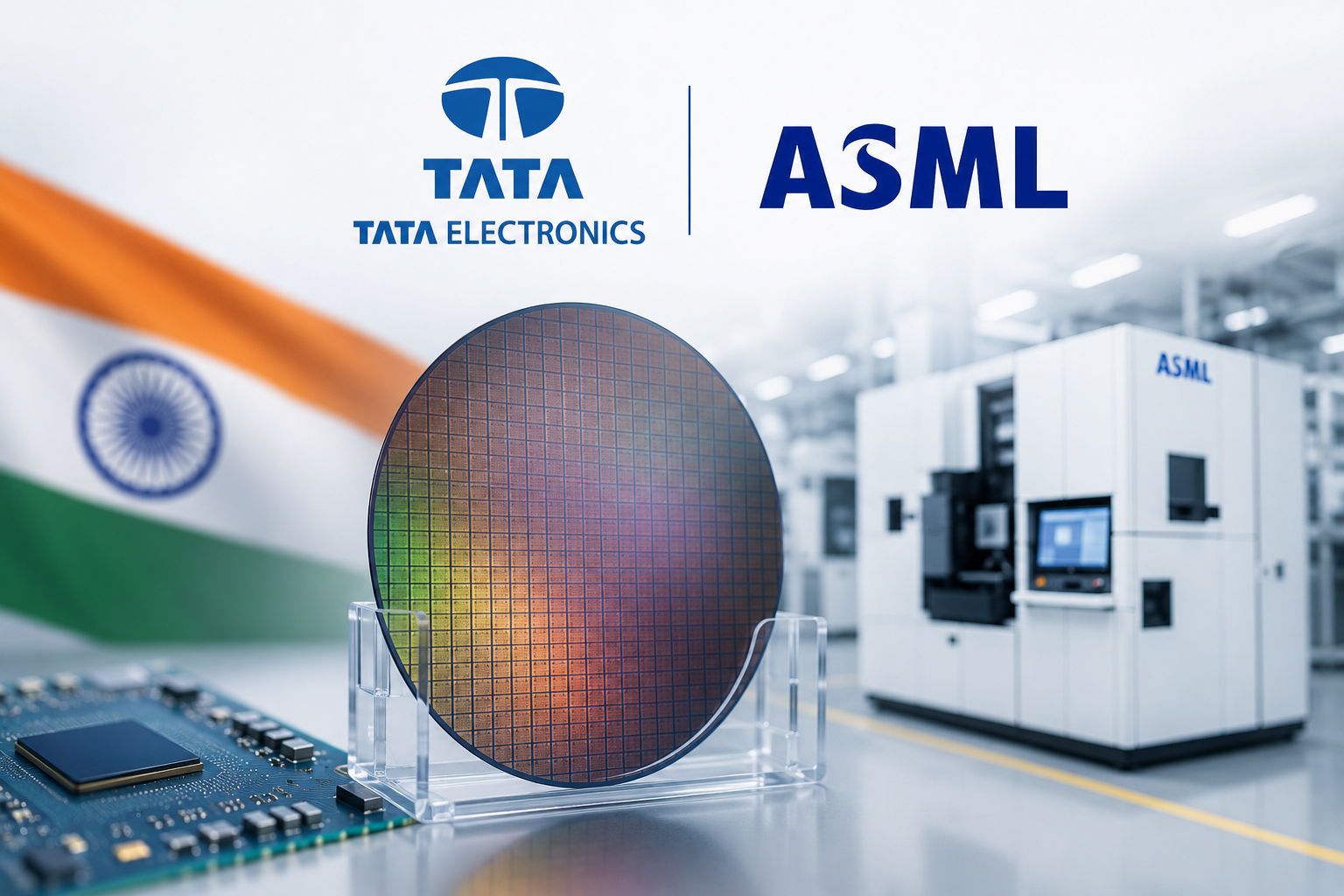
India’s semiconductor ambitions received a significant boost as Tata Electronics and ASML announced a strategic partnership aimed at strengthening the country’s chip manufacturing ecosystem.
The agreement, witnessed in the presence of Prime Minister Narendra Modi, is being viewed as an important milestone in India’s long-term goal of building a globally competitive semiconductor manufacturing industry.
At a time when countries worldwide are racing to secure semiconductor supply chains and reduce dependence on imports, the collaboration between one of the world’s most critical chip equipment companies and one of India’s largest industrial groups could play a transformative role in shaping India’s electronics manufacturing future.
Why This Partnership Matters?
Semiconductors power almost everything in the modern digital economy.
From:
- smartphones
- laptops
- automobiles
- AI systems
- telecom networks
- defense technology
- medical equipment
to cloud infrastructure and advanced computing, chips have become the backbone of global technology. However, semiconductor manufacturing remains one of the world’s most complex and strategically important industries.
For decades, chip manufacturing capabilities have largely remained concentrated in a few regions globally, particularly:
- Taiwan
- South Korea
- the United States
- parts of Europe
India has long aimed to become part of this ecosystem, but building semiconductor infrastructure requires enormous investments, technical expertise, global partnerships, and highly advanced manufacturing systems.
This is where the Tata-ASML collaboration becomes significant.
Who Is ASML and Why Is It Important?
ASML is one of the most strategically important companies in the global semiconductor industry.
The Dutch technology company is best known for manufacturing advanced lithography machines used in semiconductor fabrication.
These machines are essential for producing advanced microchips. In fact, ASML is one of the few companies globally capable of building extremely sophisticated lithography systems required for cutting-edge semiconductor manufacturing.
Without ASML’s technology, producing advanced chips at scale becomes extremely difficult. That’s why partnerships involving ASML are often seen as major developments in global semiconductor strategy.
Tata Electronics Is Expanding Aggressively
Tata Electronics has rapidly emerged as one of India’s key players in electronics and semiconductor manufacturing ambitions.
Over the last few years, the company has accelerated investments across:
- semiconductor manufacturing
- electronics assembly
- precision engineering
- chip ecosystem development
The company has already announced major semiconductor manufacturing plans in India and is positioning itself as a critical part of the country’s long-term electronics strategy.
The collaboration with ASML could help strengthen technological capabilities and ecosystem readiness for advanced chip manufacturing operations.
India’s Semiconductor Push Has Become Strategic
The semiconductor conversation is no longer only about technology.
Globally, it has become deeply tied to:
- economic security
- geopolitical strategy
- supply chain resilience
- AI competitiveness
- national manufacturing capabilities
The global chip shortage witnessed during and after the pandemic exposed how vulnerable international supply chains could become when semiconductor production gets disrupted.
As a result, countries around the world have started heavily investing in domestic semiconductor ecosystems.
India is also actively working to position itself as a major semiconductor manufacturing destination through:
- policy incentives
- infrastructure support
- global partnerships
- manufacturing subsidies
The Tata-ASML agreement aligns directly with this broader national strategy.
Prime Minister Modi’s Semiconductor Vision
Prime Minister Narendra Modi has repeatedly emphasized semiconductor manufacturing as a strategic priority for India.
The government has positioned electronics and semiconductor manufacturing as a key pillar of:
- Digital India
- Make in India
- Aatmanirbhar Bharat
India aims not just to consume technology, but increasingly to manufacture critical technology infrastructure domestically.
The semiconductor sector is particularly important because it influences multiple industries simultaneously, including:
- consumer electronics
- telecom
- automotive
- defense
- AI infrastructure
- industrial manufacturing
The signing of the Tata-ASML agreement in the Prime Minister’s presence signals the importance being attached to semiconductor ecosystem development at the national level.
Building a Semiconductor Ecosystem Is Not Easy
Semiconductor manufacturing is among the most capital-intensive industries globally.
Establishing a semiconductor fabrication ecosystem requires:
- advanced manufacturing infrastructure
- ultra-clean fabrication facilities
- highly skilled talent
- stable power and water supply
- precision engineering systems
- global supply chain integration
Even countries with strong manufacturing ecosystems take years to scale semiconductor capabilities. This is why partnerships with global technology leaders become especially important.
India’s semiconductor ambitions will likely depend heavily on long-term collaborations involving:
- technology transfer
- ecosystem building
- training and talent development
- manufacturing partnerships
The Tata-ASML collaboration may help accelerate some of these efforts.
Also read: https://circleofnews.in/dentsu-wins-tata-group-ipl-media-mandate/
Why Semiconductors Matter for India’s Future?
India is one of the world’s fastest-growing digital economies.
The country’s growing demand for:
- smartphones
- electric vehicles
- AI systems
- cloud infrastructure
- connected devices
- advanced electronics
is expected to increase semiconductor consumption significantly over the coming decade. At present, India imports a large share of its semiconductor requirements.
Building domestic manufacturing capabilities could potentially help:
- reduce import dependence
- strengthen supply chains
- create high-value jobs
- attract global investments
- improve technological self-reliance
Semiconductors are increasingly being viewed not just as industrial products, but as strategic national assets.
AI and Advanced Computing Are Accelerating Chip Demand
The global AI boom is also dramatically increasing semiconductor demand worldwide. AI systems require highly advanced chips capable of processing massive computational workloads.
As industries adopt:
- generative AI
- automation
- machine learning
- cloud computing
- advanced robotics
the need for semiconductor manufacturing capacity is expected to rise sharply. This creates a major long-term opportunity for countries investing early in semiconductor infrastructure.
India’s semiconductor ecosystem ambitions are therefore closely linked to its broader technology and AI growth strategy.
The Bigger Challenge: Execution
While announcements and partnerships are important, the real challenge lies in execution. Semiconductor ecosystems typically take years to mature.
Success will depend on:
- consistent policy support
- infrastructure readiness
- talent development
- global supply chain integration
- sustained investments
India is still in the early stages of building a large-scale semiconductor manufacturing ecosystem, but partnerships like Tata-ASML indicate growing momentum.
Industry experts believe long-term commitment will be essential for India to emerge as a globally competitive semiconductor hub.
What This Means for India’s Tech Industry?
The Tata-ASML partnership is not just about one project.
It represents a broader signal that India is becoming increasingly serious about entering the global semiconductor value chain.
If executed successfully, semiconductor manufacturing growth could positively impact:
- electronics manufacturing
- AI innovation
- automotive technology
- telecom infrastructure
- startup ecosystems
- advanced engineering industries
The ripple effect across India’s broader technology economy could be substantial.
Conclusion
The strategic partnership between Tata Electronics and ASML marks an important step in India’s semiconductor journey.
As global competition around chip manufacturing intensifies, India is increasingly positioning itself as a serious participant in the future of advanced technology manufacturing.
While building a semiconductor ecosystem is a long-term process requiring sustained investment and execution, collaborations like these could help accelerate India’s transition from a technology consumption market to a technology manufacturing powerhouse.
And in the coming decade, semiconductors may become one of the most defining sectors shaping India’s digital and industrial future.
