

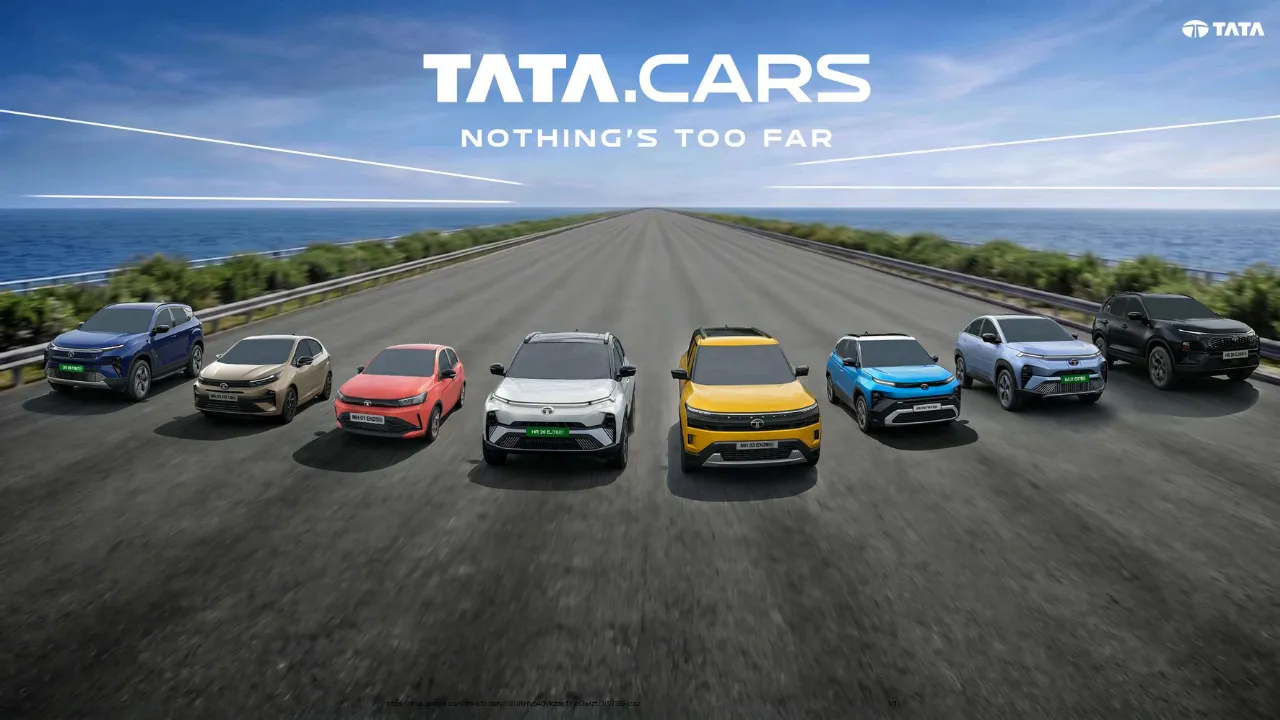
Tata Motors Passenger Vehicles has introduced a new consumer-facing brand identity, TATA.CARS, along with a new brand promise, “Nothing’s Too Far.” The move brings Tata’s passenger cars and electric vehicles under a more unified identity as the company looks to connect with a younger, more aspirational generation of Indian car buyers.
The change is more than a new logo or tagline. It comes at an important stage for Tata’s passenger vehicle business, which is navigating a rapidly changing Indian automobile market, growing electric vehicle adoption and increasingly diverse consumer expectations.
Tata Motors cars are now TATA.CARS
The headline change is simple: Tata Motors’ passenger vehicle business will be presented to consumers as TATA.CARS.
The company says the new identity is designed to make its passenger vehicle portfolio easier to understand and create a more consistent brand experience across its conventional and electric cars.
Importantly, this is a consumer-facing brand identity change. The legal entity continues to be Tata Motors Passenger Vehicles Limited.
The cars themselves are also not being renamed. Models such as the Nexon, Punch, Harrier, Safari, Tiago and Sierra will continue with their existing names, while the Tata logo on the vehicles remains unchanged.
The new TATA.CARS identity will gradually appear across customer touchpoints including websites, retail outlets, social media, digital channels and advertising.
Why did Tata Motors introduce TATA.CARS?
The rebranding comes as Tata’s passenger vehicle business enters a new phase. According to the company, today’s consumers are less interested in categorising vehicles simply as hatchbacks, SUVs or EVs. They are looking for cars that fit their lifestyles, ambitions and individual needs.
That thinking sits at the heart of the new TATA.CARS identity. The company wants to move from communicating a collection of different vehicle categories to presenting a more unified consumer proposition.
In simple terms, Tata wants consumers to see one modern passenger-car brand rather than separate pieces of a large portfolio.
This is particularly relevant as Tata expands across petrol, diesel and electric vehicles while also preparing for future mobility technologies.
“Nothing’s Too Far” is the new brand promise
Alongside the new TATA.CARS identity comes the tagline:
“Nothing’s Too Far”
The new brand promise replaces the earlier “Connecting Aspirations” positioning.
Tata says the new line is built around the idea of ambition – that no dream, destination or aspiration is beyond reach. From a marketing perspective, the change is significant. “Connecting Aspirations” spoke largely about Tata’s role in helping Indians move forward.
“Nothing’s Too Far” is more expansive. It attempts to connect the automobile with personal ambition, exploration and possibility.
That gives the brand greater room to communicate beyond individual products.
A new visual identity for TATA.CARS
The rebrand also introduces a new visual and sonic identity. At the centre of the design system is “Parallel Pathways”, a visual concept inspired by Tata’s iconic “T” and the idea of roads and individual journeys. The identity also introduces what Tata describes as “Ambition Blue”, alongside a new typeface and sonic identity.
The intention is to create a more consistent experience across different consumer touchpoints.
For a brand with a portfolio ranging from compact cars to premium SUVs and electric vehicles, consistency can become particularly important.
The rebrand comes after Tata Motors’ major restructuring
The timing of the new identity is also important. Tata Motors’ passenger vehicle business became an independent company following the demerger of Tata Motors, with Tata Motors Passenger Vehicles Limited coming into existence in October 2025. The passenger vehicle entity houses Tata’s domestic passenger cars and its electric vehicle business, while Tata’s commercial vehicle operations sit under a separate entity.
That restructuring provides a natural backdrop for a fresh consumer identity.
TATA.CARS can therefore be seen as part of a broader effort to define what the passenger vehicle business stands for as an independent automotive company.
Tata is targeting a new generation of car buyers
The Indian car market has changed significantly. Consumers today have more choices, access to more information and increasingly different expectations from their vehicles. Safety, technology, connectivity, design, performance and sustainability are all playing larger roles in purchase decisions.
Tata’s new identity appears designed to respond to this shift. The company has positioned itself as an important player in India’s electric vehicle market, while its conventional portfolio continues to be an important part of its business.
The challenge is bringing these different propositions together without confusing consumers.
TATA.CARS is essentially Tata’s answer to that challenge.
EVs will remain central to the strategy
Electric mobility is another major reason the new identity matters.
Tata was among the early large Indian carmakers to establish a strong presence in passenger EVs. Its electric portfolio includes models such as the Punch EV and Nexon EV, while newer products continue to expand its presence in the segment.
But the EV market is becoming much more competitive. As more automakers enter the segment, consumers are becoming more sophisticated about range, charging, technology, performance and features.
Tata says EV adoption is also moving beyond early adopters, creating different consumer groups with very different requirements.
That means the company needs a brand identity capable of accommodating a much broader EV audience.
One showroom, multiple powertrains
Another interesting part of Tata’s strategy is the increasing integration of electric and conventional vehicles. The company says there is less need for EV-exclusive retail spaces as electric vehicles become more mainstream.
Instead, customers can increasingly encounter electric and internal-combustion-engine vehicles within the same retail environment. This makes the unified TATA.CARS identity particularly relevant.
Rather than creating a sharp divide between “Tata cars” and “Tata EVs,” the company is positioning them as part of one broader passenger vehicle ecosystem.
What will actually change for customers?
For consumers, the transition will be gradual. The new TATA.CARS identity will increasingly appear across:
- Tata’s website
- Dealerships and retail outlets
- Digital platforms
- Social media
- Advertising
- Other consumer-facing touchpoints
However, existing vehicle names and products remain unchanged. The Tata badge on the cars also remains the same.
So, someone buying a Nexon or Safari will still be buying a Tata vehicle. The difference will increasingly be in how the overall passenger vehicle business presents itself.
Why the rebrand matters from a marketing perspective
Tata’s move is interesting because it reflects a broader trend in automotive branding. Car companies are no longer selling only mechanical products. They are increasingly selling technology, experiences, lifestyles and aspirations.
A modern car brand needs to speak across multiple generations, fuel types and consumer use cases.
TATA.CARS gives Tata a simpler platform from which to do that. Instead of communicating dozens of individual product stories in isolation, the company can build a larger brand narrative and then connect individual cars to it.
The new “Nothing’s Too Far” promise also gives Tata a flexible platform that can work across products, campaigns and markets.
What happens next for TATA.CARS?
The success of the rebrand will ultimately depend on what Tata does with it. A new identity can create attention, but sustained brand value comes from consistent products, customer experience and communication.
Tata says its ambition is to reach 20% market share, making the new identity part of a much larger growth agenda.
The company is also looking to build a brand that can work beyond India as its passenger vehicle business expands internationally. That makes the TATA.CARS identity more than a cosmetic refresh.
It is an attempt to create a single, modern consumer-facing identity for Tata’s passenger vehicle business at a time when the automobile itself is changing rapidly.
The bigger picture
Tata Motors’ transition to TATA.CARS is not a renaming of every Tata car. It is a repositioning of the passenger vehicle business under a simpler and more unified consumer identity.
The company’s cars remain the same, but the way Tata wants consumers to experience the portfolio is changing.
With “Nothing’s Too Far” as its new promise, TATA.CARS is betting on a message built around ambition, mobility and possibility.
And as India’s automotive market moves towards a mix of electric vehicles, connected technology and increasingly personalised mobility, Tata clearly wants its brand to move with it.
