

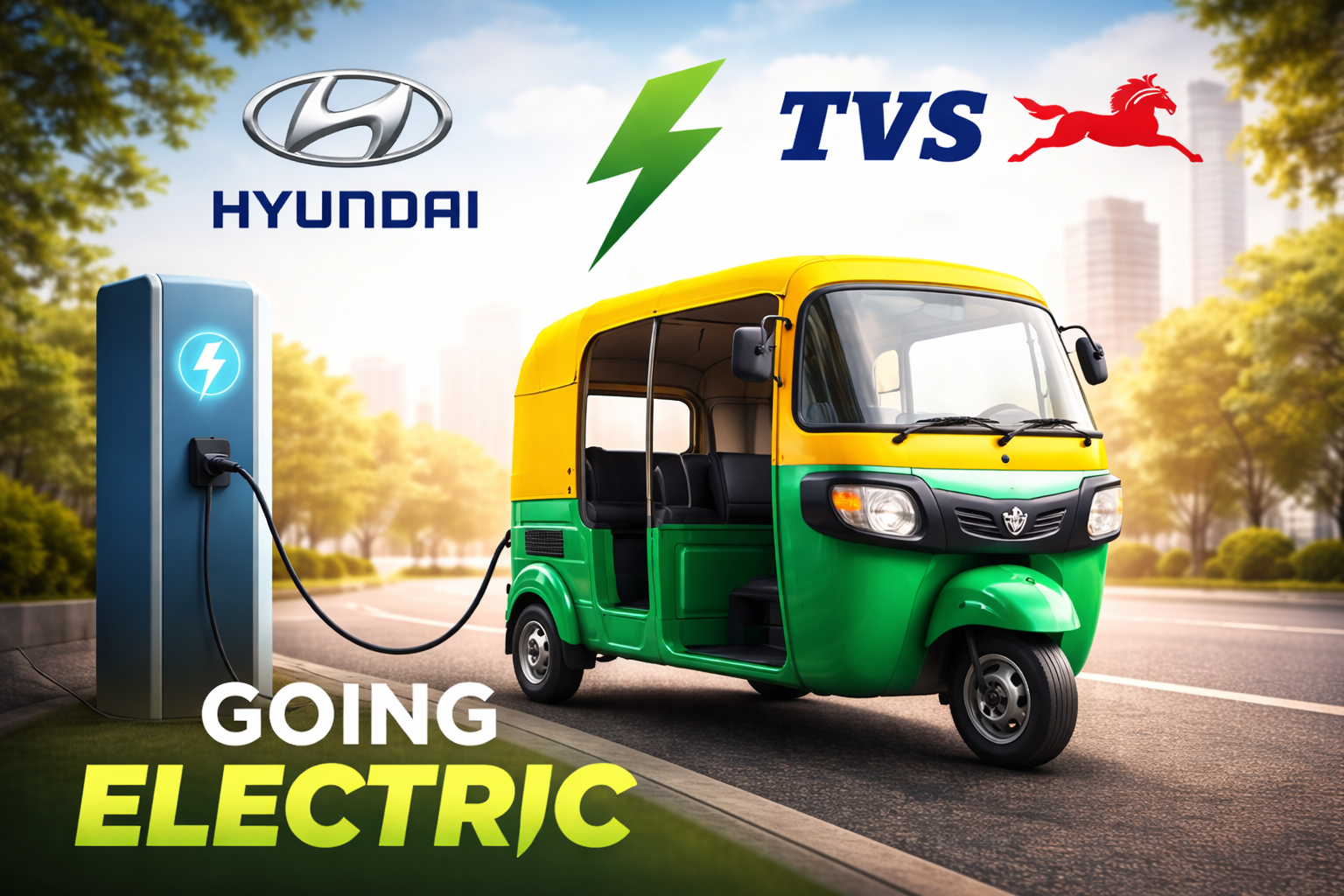
India’s electric mobility journey is gaining serious momentum — and a new partnership could accelerate it even further. Hyundai Motor Company and TVS Motor Company have joined hands to co-develop electric three-wheelers for the Indian market, marking a significant step toward transforming last-mile mobility.
This collaboration is not just another EV announcement. It represents a strategic convergence of global automotive expertise and strong local market understanding — aimed at one of India’s most critical transportation segments.
Why Electric Three-wheelers Matter in India?
To understand the importance of this partnership, one must first understand the role of three-wheelers in India.
Three-wheelers are:
- a backbone of last-mile connectivity
- widely used for passenger transport (auto-rickshaws)
- essential for small-scale goods movement
Millions of Indians rely on them daily for:
- commuting
- deliveries
- small business operations
However, traditional three-wheelers are often powered by:
- petrol
- diesel
- compressed natural gas (CNG)
These contribute to:
- air pollution
- fuel costs
- carbon emissions
Electric three-wheelers offer a cleaner, more efficient alternative.
The Hyundai–TVS Collaboration: What We Know
Under the partnership:
- Hyundai Motor will bring design, engineering, and technology expertise
- TVS Motor will focus on manufacturing, localization, and market execution
The companies aim to jointly develop:
- electric three-wheelers tailored for Indian conditions
- solutions for both passenger and cargo segments
The partnership leverages Hyundai’s global EV capabilities and TVS Motor’s deep understanding of the Indian mobility ecosystem.
A Strategic Fit: Global Meets Local
This collaboration is a classic example of global capability meeting local execution.
Hyundai’s Strengths:
- advanced EV technology
- global R&D capabilities
- design and innovation expertise
TVS Motor’s Strengths:
- strong distribution network in India
- manufacturing scale
- understanding of Indian consumers
Together, they create a powerful combination that can:
- accelerate product development
- ensure cost efficiency
- improve adoption rates
Why This Move Is Significant?
The partnership stands out for several reasons.
1. Focus on Mass Mobility
Unlike premium EV segments, three-wheelers impact everyday mobility for millions.
2. High Adoption Potential
Electric three-wheelers are already gaining traction due to lower running costs.
3. Policy Support
Government incentives and EV policies are encouraging adoption.
4. Sustainability Goals
The move aligns with India’s push toward reducing emissions.
The Economics of Electric Three-wheelers
One of the biggest advantages of electric three-wheelers is cost efficiency. Compared to traditional vehicles, they offer:
- lower fuel costs (electricity vs petrol/diesel)
- reduced maintenance expenses
- longer operational life in some cases
For drivers and fleet operators, this translates to:
- higher savings
- improved profitability
This economic advantage is a key driver of EV adoption in the segment.
Government Push and Policy Support
India has been actively promoting electric mobility through:
- subsidies and incentives
- state-level EV policies
- infrastructure development
Schemes like FAME (Faster Adoption and Manufacturing of Electric Vehicles) have played a crucial role.
The Hyundai–TVS partnership aligns with these policy goals by:
- promoting clean mobility
- encouraging local manufacturing
- reducing dependence on fossil fuels
Challenges in the EV Three-Wheeler Segment
Despite strong potential, the segment faces challenges.
1. Charging Infrastructure
Limited charging stations can impact adoption.
2. Battery Costs
Batteries remain a significant portion of vehicle cost.
3. Range Anxiety
Drivers may worry about vehicle range and charging availability.
4. Financing
Access to affordable financing for EVs is still evolving.
The success of this partnership will depend on how effectively these challenges are addressed.
Technology and Innovation: What to Expect
With Hyundai’s involvement, the new electric three-wheelers could feature:
- improved battery efficiency
- better range
- enhanced safety features
- smart connectivity solutions
Innovation will be key to differentiating products in a competitive market.
Impact on Competition
The electric three-wheeler market in India is already competitive, with several players offering products. The entry of a Hyundai–TVS collaboration could:
- raise the bar for quality and performance
- accelerate innovation across the industry
- intensify competition
This ultimately benefits consumers through better products and pricing.
Boost to Make in India
The partnership is also aligned with the “Make in India” initiative.
By focusing on:
- local manufacturing
- supply chain development
- domestic production
the companies can:
- reduce costs
- create jobs
- strengthen India’s EV ecosystem
Environmental Impact
Electric three-wheelers can significantly reduce:
- air pollution
- greenhouse gas emissions
- dependence on fossil fuels
Given the large number of three-wheelers on Indian roads, even partial electrification can have a major environmental impact.
Future of Last-Mile Mobility
Last-mile mobility is evolving rapidly.
Key trends include:
- electrification
- digital integration
- shared mobility models
Electric three-wheelers are expected to play a central role in this transformation. The Hyundai–TVS partnership positions both companies to benefit from this shift.
What This Means for Consumers?
For consumers and drivers, this partnership could lead to:
- more reliable EV options
- improved performance
- better affordability over time
As technology improves and costs decline, adoption is likely to increase.
Investor Perspective
For investors, this move signals:
- growing confidence in the EV segment
- long-term growth opportunities
- strategic positioning by major companies
The partnership reflects a broader trend of traditional automakers investing in electric mobility.
What Happens Next?
The next steps in the partnership may include:
- product development
- testing and validation
- regulatory approvals
- market launch
Timelines will depend on development progress and market conditions.
Conclusion
The partnership between Hyundai Motor Company and TVS Motor Company marks a significant step in India’s electric mobility journey. By focusing on electric three-wheelers — a segment that directly impacts millions — the collaboration has the potential to:
- accelerate EV adoption
- improve last-mile connectivity
- contribute to environmental sustainability
As India moves toward a cleaner and more efficient transportation system, partnerships like this will play a crucial role in shaping the future.

1 Comment
Pingback: VELVEX Partners Lucknow Super Giants for IPL 2026