

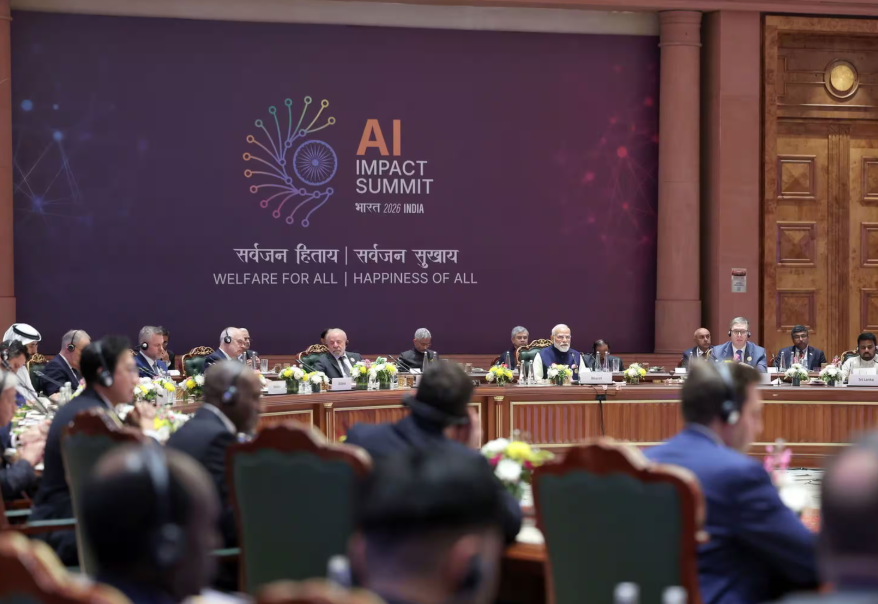
The AI Summit 2026, officially known as the AI Impact Summit 2026, concluded in New Delhi after six days of high-level dialogue, multi-billion-dollar announcements, and ambitious policy declarations that may shape the next decade of artificial intelligence.
Hosted at the iconic Bharat Mandapam, the summit brought together delegates from over 110 countries, global technology leaders, startup founders, researchers, and policymakers. From sovereign AI to infrastructure expansion and ethical governance, the message was clear: India intends to play a decisive role in the global AI ecosystem.
Massive Investment Announcements Dominate AI Summit 2026
One of the defining highlights of the AI Summit 2026 was the scale of financial commitments announced during the event. Investment pledges crossed hundreds of billions of dollars, targeting compute infrastructure, AI research, startup funding and public digital frameworks.
India announced plans to add 20,000 GPUs to its national AI compute grid, aiming to democratise access for researchers, startups and academic institutions. The move is expected to reduce dependency on overseas infrastructure while strengthening domestic innovation significantly.
Among the headline announcements:
- A strategic collaboration between the Tata Group and OpenAI to expand scalable AI infrastructure in India
- A proposed 15 billion dollar AI hub by Google in Visakhapatnam
- Expanded public and private funding pipelines to support early-stage AI startups
These announcements signalled that AI is no longer viewed as a future technology but as present day economic infrastructure.
Global Leaders Call for Responsible and Inclusive AI
The summit was not only about investment. It also focused heavily on AI governance and ethics. India’s Prime Minister, alongside leaders such as Emmanuel Macron and Rishi Sunak, emphasised the need for responsible development and deployment of artificial intelligence.
The theme of AI Summit 2026 was “Sarvajan Hitaya, Sarvajan Sukhaya” Welfare for all, Happiness of all), promoting human-centric, inclusive AI.
Key governance discussions included:
- Global standards for AI safety
- Tackling misinformation and deepfakes
- Transparent and accountable AI systems
- Ethical guardrails for generative AI
India also introduced its MANAV framework, focusing on moral systems, accountable governance, national sovereignty, accessibility and legitimacy in AI applications.
Youth Engagement and Public Participation
Beyond boardrooms and policy halls, the summit also focused on public engagement. Hundreds of thousands of students reportedly took responsible AI pledges during associated events, signalling efforts to build awareness around ethical technology use.
Sector-specific showcases demonstrated real-world applications of AI in:
- Precision agriculture
- Digital health diagnostics
- Smart governance systems
- Financial services automation
The emphasis on skill development and workforce readiness was particularly strong, with multiple announcements around AI training programmes and digital literacy initiatives.
The Road Ahead
As the curtains fall on the AI Summit 2026, the spotlight now shifts to execution. Investment commitments must translate into operational infrastructure. Governance principles must become enforceable policy. And innovation must remain inclusive.
If the announcements made at Bharat Mandapam are realised, India’s AI ambitions could reshape not only its own digital economy but also the global balance of technological power.
For now, one thing is clear: the AI Summit 2026 has firmly placed India at the centre of the global artificial intelligence conversation.

1 Comment
Pingback: India’s First Quantum & AI University Campus to Be Set Up in Amaravati by NIELIT & Andhra Pradesh - Circle of News