

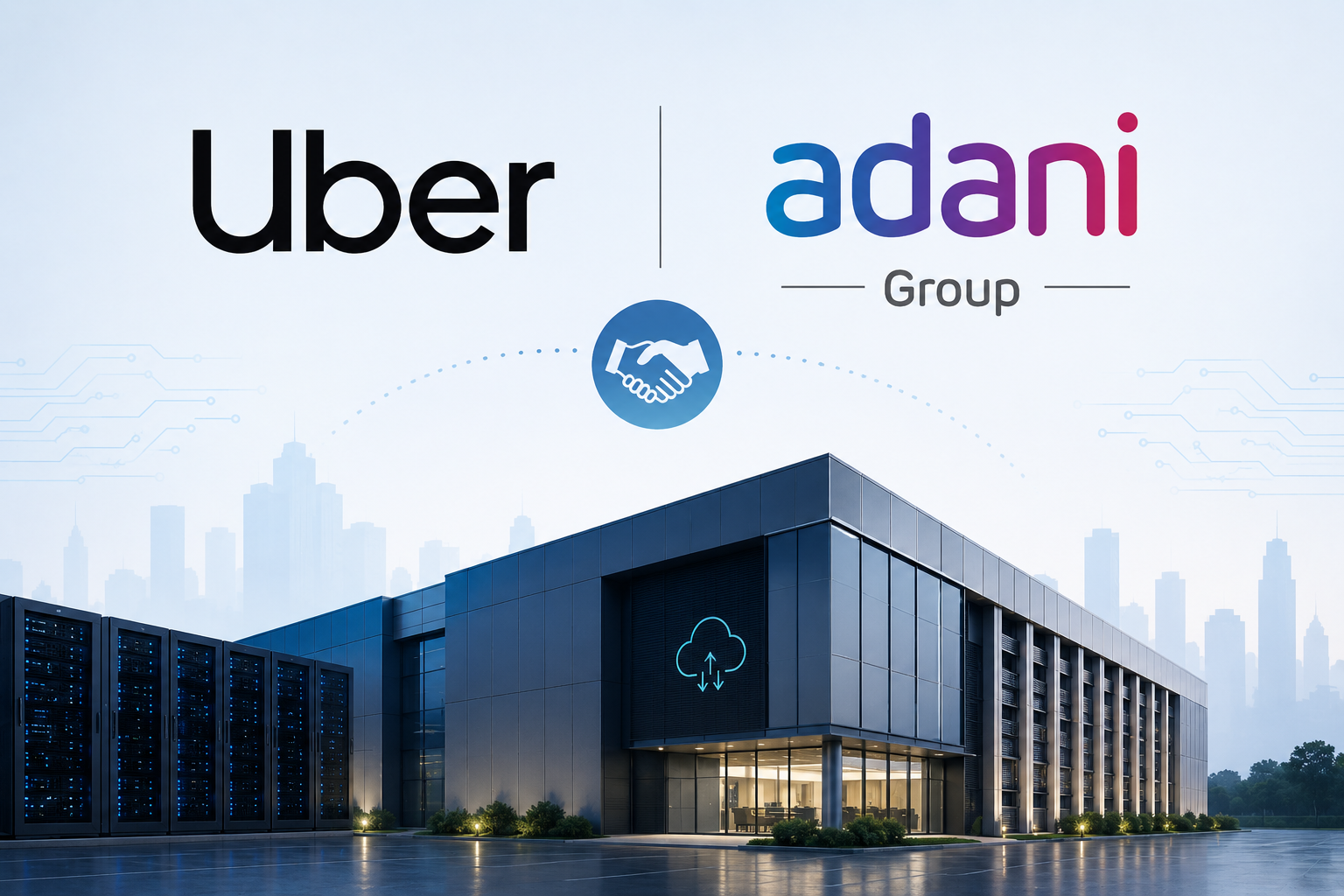
Uber is partnering with Adani Group to establish its first data centre in India, marking a major step in the ride-hailing giant’s long-term digital infrastructure strategy in the country.
The upcoming facility, expected to be located in Ahmedabad, reflects the growing importance of localized data infrastructure as global technology companies expand deeper into India’s digital ecosystem.
While Uber is widely known for mobility and ride-hailing services, the move signals how technology companies are increasingly investing in large-scale backend infrastructure to support:
- data processing
- AI systems
- cloud operations
- real-time analytics
- digital scalability
And with India rapidly emerging as one of the world’s largest digital markets, data centres are becoming a critical part of that expansion story.
Why Uber’s India Data Centre Matters?
This will reportedly be Uber’s first dedicated data centre in India. Until now, much of the company’s infrastructure operations have relied on global systems outside the country.
The decision to establish local infrastructure comes at a time when:
- data localization conversations are growing globally
- AI workloads are increasing rapidly
- digital platforms require lower latency systems
- real-time mobility operations are becoming more complex
India is also witnessing explosive growth in:
- app-based services
- digital transactions
- mobility platforms
- cloud adoption
- AI-driven technologies
Why the Partnership With Adani Group Is Significant?
Adani Group has been aggressively expanding its presence across digital infrastructure, energy, logistics, and data centre ecosystems over the last few years. The partnership with Uber highlights how large Indian conglomerates are positioning themselves as infrastructure partners for global technology companies.
As a result, localized digital infrastructure is becoming increasingly important for global tech companies operating at scale.
Data centres today are not simply storage facilities.
They form the backbone of:
- AI computing
- cloud ecosystems
- enterprise applications
- mobility technology
- large-scale digital platforms
For Adani Group, the collaboration further strengthens its ambitions within India’s growing digital infrastructure market.
For Uber, partnering with an established infrastructure player may help accelerate deployment and operational scalability.
Ahmedabad Emerging as a Digital Infrastructure Hub
The choice of Ahmedabad is also noteworthy. India’s digital infrastructure investments have traditionally concentrated around cities such as:
- Mumbai
- Hyderabad
- Bengaluru
- Chennai
However, newer cities are increasingly entering the conversation as businesses look for:
- infrastructure scalability
- land availability
- energy access
- strategic connectivity
- long-term operational efficiency
Ahmedabad’s growing industrial and infrastructure ecosystem is gradually helping position the city as a potential emerging technology and data infrastructure destination.
The Bigger Picture: Data Centres Are Becoming Strategic Assets
Globally, data centres are becoming some of the most valuable infrastructure assets in the digital economy.
Every major technology trend today depends heavily on data infrastructure, including:
- artificial intelligence
- cloud computing
- mobility platforms
- streaming services
- fintech ecosystems
- enterprise software
As user demand increases, companies need faster, more localized systems capable of processing enormous volumes of data in real time.
For mobility companies like Uber, this becomes even more important because ride-matching, navigation, payments, dynamic pricing, and customer support all rely on large-scale computing infrastructure.
India’s Data Centre Market Is Growing Rapidly
India’s data centre ecosystem is currently witnessing rapid investment from both domestic and international players.
Several factors are driving this growth:
- rising internet penetration
- AI adoption
- 5G rollout
- digital payments growth
- increasing enterprise digitization
- government focus on digital infrastructure
Industry experts believe India could become one of the fastest-growing global markets for data infrastructure over the next decade.
This is also attracting investments from:
- cloud providers
- technology giants
- telecom companies
- infrastructure conglomerates
- AI-focused enterprises
Uber’s latest move fits directly into this larger trend.
Data Localization and Regulatory Considerations
The growing focus on local data infrastructure also aligns with broader discussions around data sovereignty and localization.
Countries worldwide are increasingly emphasizing:
- domestic data storage
- cybersecurity
- digital sovereignty
- local infrastructure resilience
For global companies operating in India, localized data centres may help improve:
- compliance readiness
- data security
- operational efficiency
- service reliability
While Uber has not positioned the move explicitly around regulation, the broader global trend toward localized infrastructure likely plays a role in such strategic decisions.
AI and Real-Time Computing Are Changing Infrastructure Needs
Another important factor behind rising data centre investments is artificial intelligence. AI-powered systems require enormous computational capacity and real-time processing capabilities.
Mobility platforms increasingly depend on AI for:
- route optimization
- demand prediction
- safety systems
- driver allocation
- customer experience personalization
As AI adoption accelerates, infrastructure requirements are becoming significantly more advanced.
This is one reason why technology companies worldwide are racing to strengthen backend infrastructure capabilities.
India Is Becoming Central to Global Tech Expansion
Over the last decade, India has evolved from being primarily a user market into a strategic technology growth market.
Today, India represents:
- one of the world’s largest internet populations
- a rapidly digitizing economy
- a major AI growth opportunity
- a fast-scaling consumer technology market
Global companies are no longer viewing India solely as an operational market. Increasingly, they are building long-term infrastructure within the country itself. Uber’s partnership with Adani reflects that broader strategic shift.
Conclusion
Uber partnering with Adani Group to establish its first India data centre marks an important development in the country’s evolving digital infrastructure landscape.
The move goes beyond mobility services.
It highlights how:
- data infrastructure
- AI scalability
- cloud ecosystems
- localized computing
- digital sovereignty
are becoming central to the next phase of technology growth in India.
As global technology companies continue investing deeper into India’s digital ecosystem, partnerships like these could play a major role in shaping the country’s future as a global infrastructure and technology hub.

1 Comment
Pingback: Gautam Adani Launches ₹150 Cr Rural Eye Care Initiative in Bihar