

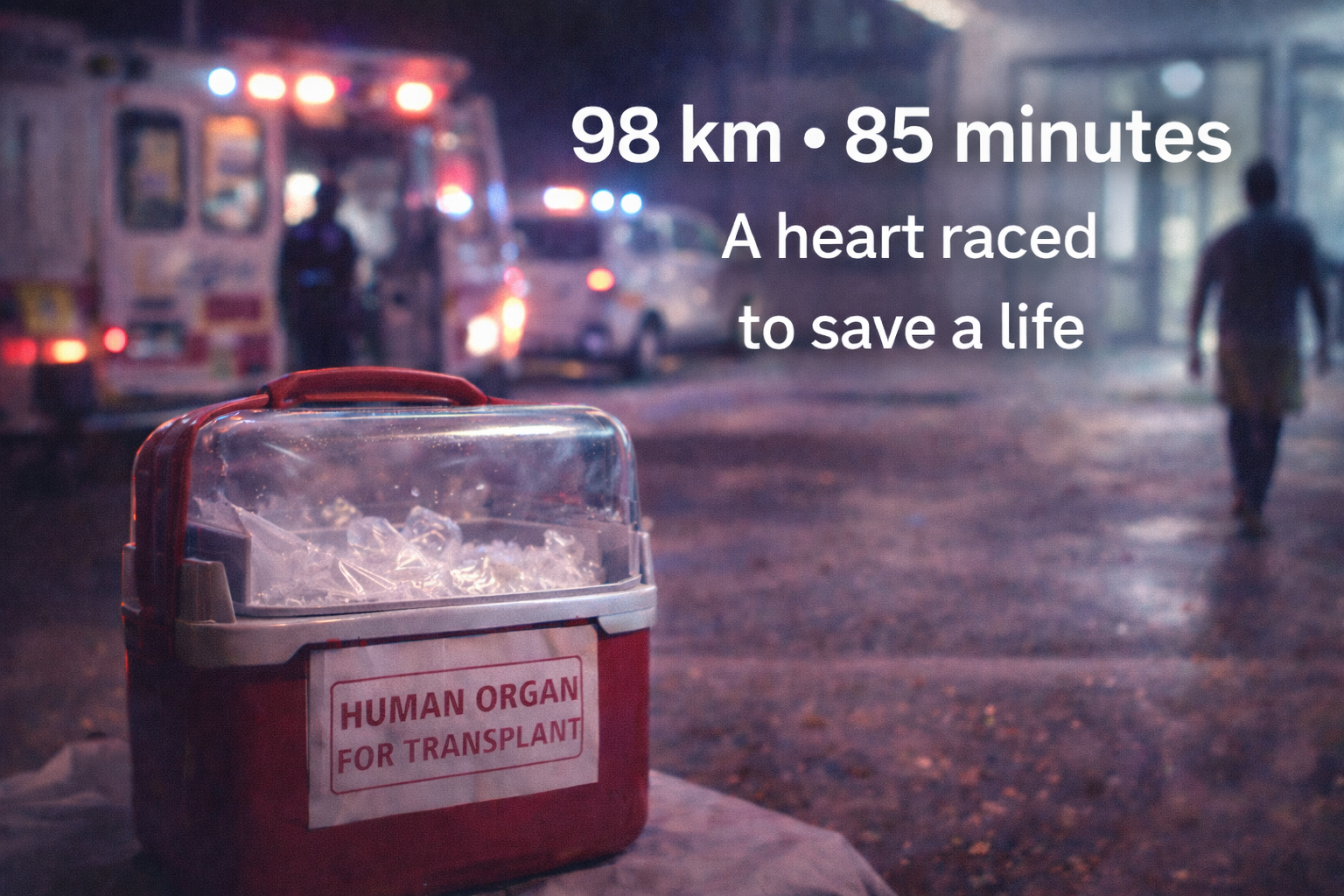
Sometimes, a road is not just a road. Sometimes, it becomes the thin line between life and death.
On an ordinary afternoon, a 98-kilometre stretch between Rohtak and Delhi turned into a race against time, carrying something far more precious than any cargo — a beating donor heart and the hope of a second life.
In just 85 minutes, the heart of a 37-year-old donor was transported from PGIMS Rohtak to Fortis Escorts Heart Institute in Delhi’s Okhla through a specially created green corridor, where traffic signals were synchronised and roads cleared to ensure every minute counted.
At the end of that urgent journey waited a 26-year-old patient battling advanced dilated cardiomyopathy, whose weakened heart had left him with little hope except a transplant.
What followed was not just a medical operation. It was a profoundly human story of grief, generosity, coordination, and life.
The Beginning of a Life-saving Race
The story began in Rohtak, where a 37-year-old man was brought to PGIMS after being found unconscious on the roadside. Doctors diagnosed him with intracranial haemorrhage, a severe brain bleed.
Despite all efforts, he was later declared brain dead. For any family, this is the kind of moment words cannot fully capture.
Shock.
Pain.
Silence.
And yet, in the middle of that unimaginable grief, the family made a decision that changed several lives forever. They consented to organ donation. That one selfless act turned personal tragedy into a chain of hope.
A Family’s Decision That Saved Lives
This is perhaps the most emotional heart of the story. In India, organ donation still carries hesitation, lack of awareness, and emotional difficulty. For a grieving family to say yes in such a moment requires extraordinary courage.
Their decision ensured that multiple organs could be allocated to different patients:
- the heart went to Delhi
- the lungs were sent to Gurugram
- the liver and pancreas were allocated to AIIMS
- the kidneys and corneas remained in Rohtak
In one family’s darkest hour, several other families found renewed hope. That is the silent power of organ donation.
The Race Against Time!
Unlike many organs, a donor heart has an extremely narrow window of viability. Every passing minute affects the chances of a successful transplant. Once retrieved, the heart needed to reach Delhi quickly enough to remain viable for surgery.
The retrieval process reportedly began around 2:20 PM, and the ambulance left Rohtak at 2:50 PM.
From that moment, every second mattered. The Delhi Police and Rohtak Police coordinated to create a green corridor, clearing the entire route and synchronising traffic movement.
The ambulance covered the 98-kilometre distance in just 85 minutes, reaching Fortis Escorts at 4:15 PM.
For a route that would normally take much longer, this was a remarkable feat.
Waiting at the Other End: A 26-year-old Fighting for Life
At the other end of the corridor was a young 26-year-old patient. At an age when most people are building careers and futures, he was fighting a failing heart. Doctors said he was suffering from advanced dilated cardiomyopathy, a condition in which the heart becomes enlarged and weakened, drastically reducing its ability to pump blood.
For patients in such advanced stages, a heart transplant is often the only definitive option. For him, that donor heart was not just a medical procedure.
It was time.
It was possibility.
It was life.
The Transplant and a Second Chance
Once the heart reached the hospital, the transplant team immediately began the complex surgery. The operation was successfully carried out by the cardiac specialists at Fortis Escorts.
The patient is currently under close ICU monitoring and ventilator support as doctors continue to observe recovery. A transplant is not just a surgery. It is a rebirth. For the recipient and his family, the day will likely be remembered as the day life began again.
Also read: https://circleofnews.in/vantara-wildlife-veterinary-university-jamnagar/
Why Green Corridors Matter?
Stories like this also remind us of the extraordinary systems that work quietly in the background.
A green corridor is a specially cleared route that allows life-saving organs to be transported rapidly through city traffic. In a country where congestion can easily delay travel, these corridors save crucial minutes.
Those minutes save lives. The successful 85-minute journey from Rohtak to Delhi once again shows the importance of:
- police coordination
- emergency traffic management
- hospital synchronisation
- transplant readiness
This is public infrastructure at its most humane.
The Human Side of Healthcare
Beyond the medical details, what makes this story deeply moving is its human dimension. One family lost a loved one. Another family received hope.
Police officers, doctors, surgeons, paramedics, and coordinators all became part of one mission.
To keep a heart beating.
It is rare to see so many parts of society come together for one life-saving purpose. This is why stories like this resonate so deeply.
Why Organ Donation Conversations Matter?
India continues to face a major shortage of organ donors. Many patients spend months or years on transplant waiting lists. Stories like this can help build awareness around the life-changing impact of organ donation.
One decision saved multiple lives. Sometimes, legacy is not measured in years lived, but in lives touched after one is gone.
Conclusion
The 85-minute journey of a donor heart from Rohtak to Delhi is more than a healthcare story. It is a story of humanity. A grieving family chose generosity.
Doctors chose urgency.
Police chose action.
And somewhere in Delhi, a 26-year-old was given another chance to live. In a world often overwhelmed by difficult headlines, this story reminds us that compassion still moves faster than traffic.
And sometimes, hope travels 98 kilometres in 85 minutes!!
