

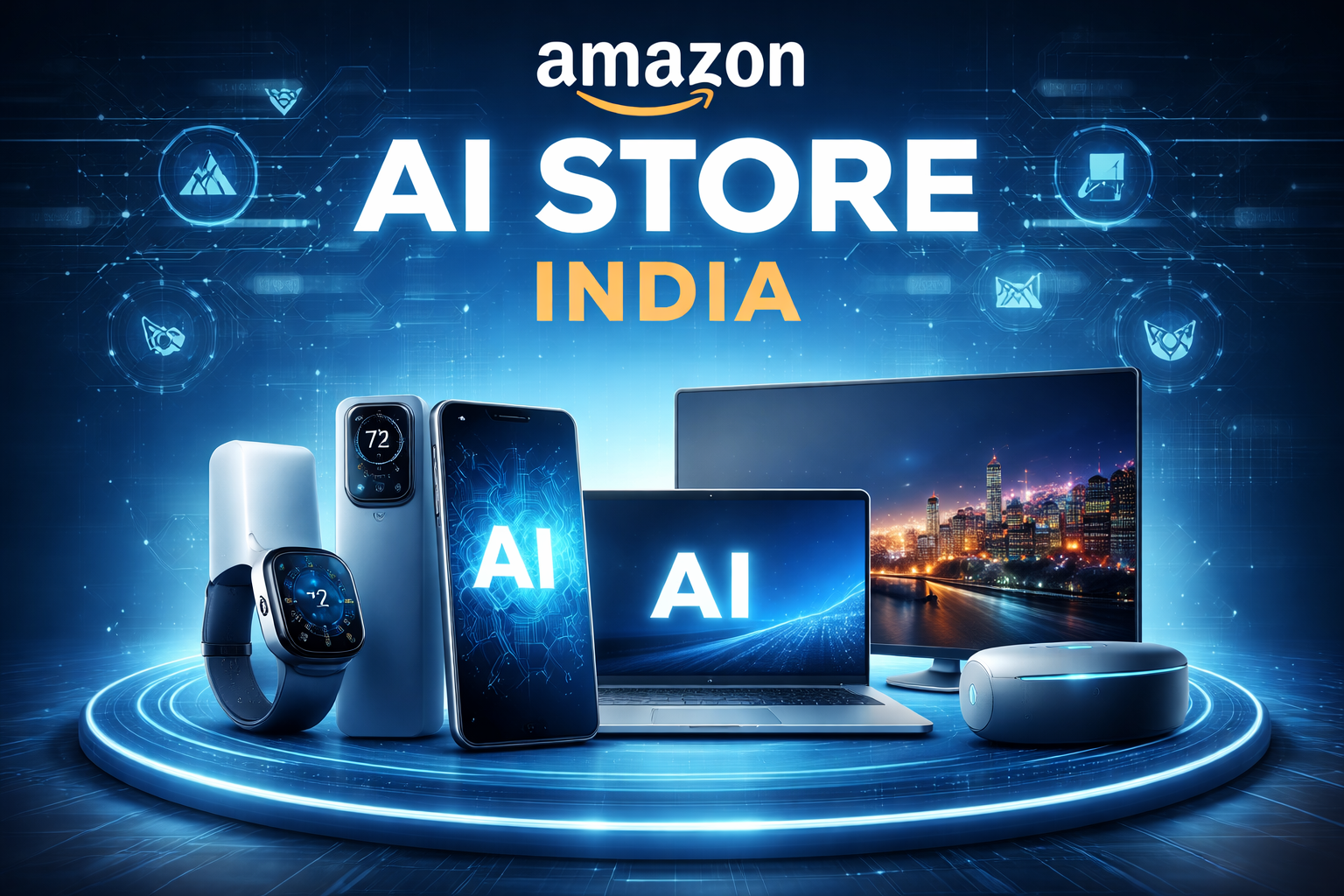
In a move that underlines how artificial intelligence is reshaping online shopping, Amazon has launched a dedicated AI Store in India, creating a centralized destination for customers looking to discover and buy AI-powered devices.
The new digital storefront is designed to simplify how consumers shop for smart electronics, from AI-enabled laptops and smartphones to televisions, wearables, home appliances, and connected devices.
This is more than just another category page. It reflects a larger shift in how e-commerce platforms are beginning to merge AI, discovery, and purchase decision-making into one seamless consumer journey.
According to recent reports, search demand for AI devices on Amazon India has grown by nearly 60% year-on-year, showing rapidly rising interest among Indian consumers.
That consumer shift is exactly what this launch is designed to address.
What Is Amazon’s New AI Store?
The newly launched AI Store is a dedicated shopping section on Amazon India that brings together products powered by artificial intelligence across multiple categories.
This includes:
- AI laptops
- AI smartphones
- smart TVs
- AI-powered ACs
- refrigerators
- washing machines
- smartwatches
- tablets
- smart glasses
Instead of customers having to search category by category, the platform now offers a single destination for AI-led electronics discovery.
This improves shopping efficiency and aligns with how consumers increasingly search for technology today.
Rather than asking for a product category, many users now search based on features like:
- better battery optimization
- AI camera tools
- privacy controls
- voice assistance
- adaptive performance
The AI Store is built around this behavior.
Why This Launch Matters
This is not just a retail announcement. It signals how AI is becoming a consumer-facing commerce layer. Earlier, AI was mostly discussed in the context of chatbots, productivity tools, or enterprise software.
Now, it is directly influencing consumer purchase journeys. Amazon is effectively saying that AI devices are no longer niche. They are becoming mainstream.
That is important for the Indian electronics market. India continues to be one of the world’s fastest-growing consumer electronics markets, especially in segments like:
- smartphones
- laptops
- smart appliances
- wearables
- connected home products
The launch recognizes that users increasingly want products that are “smart by default.”
The Rise of AI-Powered Consumer Devices
Over the past year, nearly every major electronics brand has moved toward AI integration.
Examples include:
- AI photo editing in smartphones
- adaptive battery management
- voice-enabled home appliances
- contextual computing in laptops
- AI-based screen optimization in TVs
Consumers are no longer simply buying hardware. They are buying software intelligence built into hardware. This is a major shift. An air conditioner is no longer just an AC. It is now marketed as a system that can:
- learn room temperature patterns
- optimize cooling cycles
- reduce electricity bills
- auto-adjust based on occupancy
Similarly, smartphones are increasingly sold on AI features like:
- object removal in photos
- real-time translation
- smart note summarization
- voice-to-text enhancement
Amazon’s AI Store directly responds to this trend.
A Smarter Discovery Experience
One of the biggest challenges in electronics shopping is confusion. Consumers often struggle with questions like:
- Which AI laptop is best?
- Which phone has better on-device AI?
- What does AI cooling actually mean?
Amazon’s broader AI ecosystem already includes tools such as Rufus, Review Highlights, Lens AI, and Smartchoice, which help users compare and evaluate products more effectively. The AI Store now acts as the product discovery layer on top of these capabilities.
This makes the shopping process more intuitive.
Why Indian Consumers Are Searching for AI Devices?
The 60% surge in AI device searches is one of the most important data points in this story. It shows that Indian consumers are actively moving toward AI-first purchasing decisions. This demand is being driven by:
- premium smartphone upgrades
- AI PCs
- home automation
- energy-efficient appliances
- productivity-focused gadgets
Interestingly, reports suggest this demand is not limited to metros. It is expanding beyond Tier 1 cities. That broadens the total addressable market significantly.
Amazon’s Larger India AI Push
This launch is part of Amazon’s much larger AI strategy in India. The company has already announced plans to invest $35 billion in India by 2030, with AI-led digitization being one of the core pillars.
Additionally, Amazon has been expanding:
- AI shopping tools
- AI seller support
- AI education initiatives
- AI advertising systems
This shows a long-term market commitment. The AI Store is the consumer-facing outcome of that larger investment thesis.
Also read: https://circleofnews.in/amazon-globalstar-deal-iphone-satellite-features/
A Retail Strategy Beyond Search
This move also reflects a fundamental shift in e-commerce strategy. Traditional e-commerce was built around category navigation.
Example:
Electronics → Smartphones → Brand → Model
Now discovery is becoming intent-led.
Example:
“Best AI laptop for editing”
“Phone with best AI camera”
“Smart AC with AI power saving”
This is closer to how users naturally search. Amazon is redesigning shopping around that behavior.
What This Means for Brands?
For electronics brands, this is a major opportunity. Products with strong AI-led differentiation now gain better discoverability. This may especially benefit brands in:
- premium smartphones
- laptops
- home appliances
- wearables
AI positioning may now become a stronger merchandising tool. In simple terms: better AI = better visibility
That could influence future product launches.
The Future of AI Commerce
This story is also part of a bigger retail trend. The future of e-commerce is increasingly likely to combine:
- AI search
- conversational shopping
- guided recommendations
- smart comparison
- predictive discovery
Amazon’s AI Store may be an early version of this future. Over time, this could evolve into a shopping assistant model where users ask: “Suggest the best AI laptop under ₹80,000″ and receive personalized recommendations instantly.
This is exactly where commerce is headed.
Final Thoughts
Amazon’s AI Store launch in India is more than a product discovery update. It is a signal that AI is now becoming central to how consumers shop for technology. For users, it makes electronics discovery faster and smarter.
For brands, it raises the importance of AI-led product positioning. And for India’s retail ecosystem, it marks another major step toward AI-driven commerce experiences.

2 Comments
Pingback: Kabeer Biswas Raises ₹102 Crore for New AI Startup
Pingback: Amazon India to Invest ₹2,800 Cr to Expand Logistics