

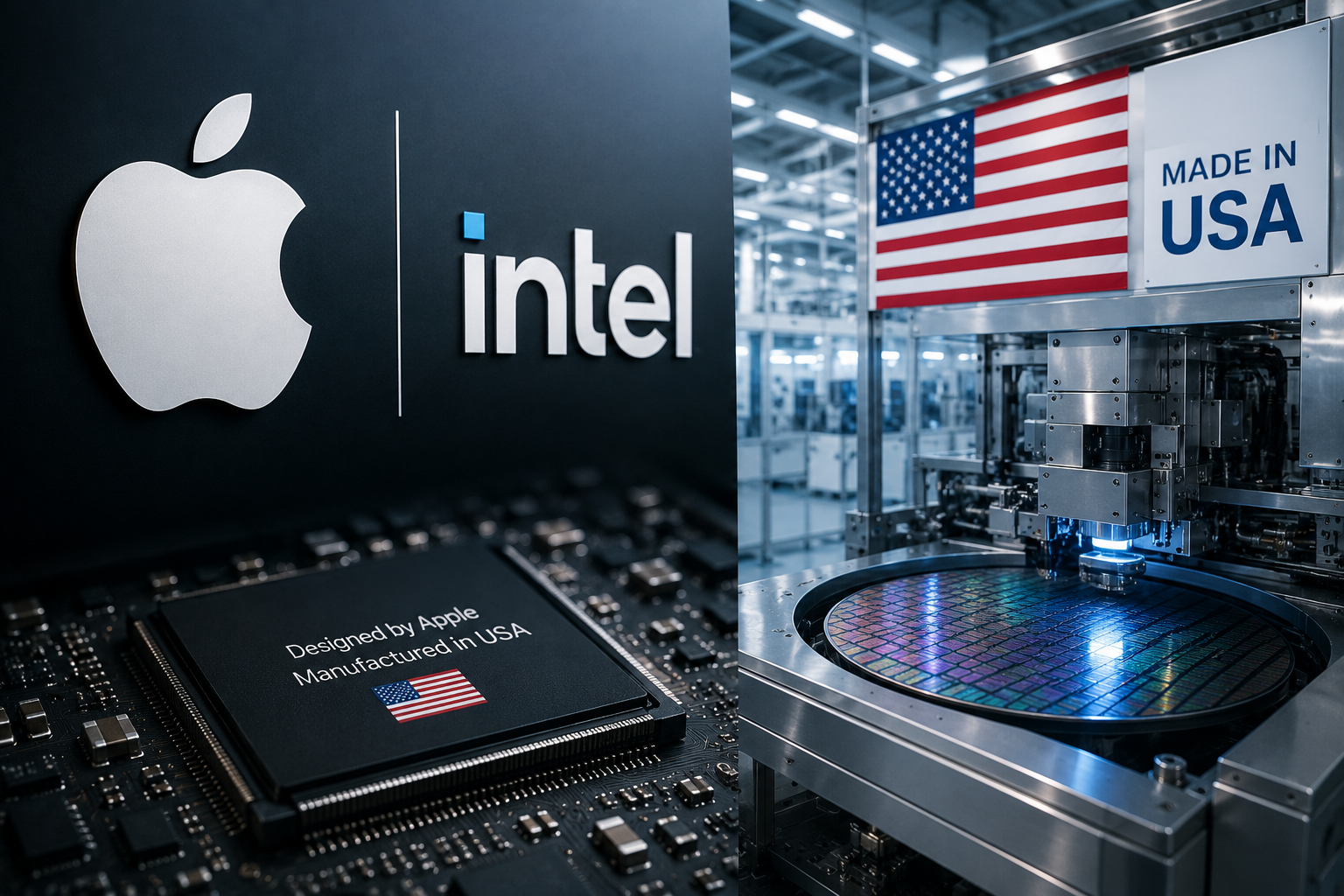
Apple and Intel have reportedly reached a preliminary agreement that could significantly reshape the future of semiconductor manufacturing in the United States.
According to multiple reports, Apple is exploring the possibility of having Intel manufacture chips for some of its devices in the US. The discussions are still at an early stage, but the development has already attracted global attention because of what it could mean for the broader technology industry, supply chains, and America’s push to strengthen domestic chip production.
The potential partnership also reflects a much larger shift happening across the global semiconductor ecosystem—one driven by geopolitics, manufacturing resilience, and the growing importance of advanced chips in everything from smartphones to artificial intelligence.
Why This Potential Deal Matters
For years, Apple has relied heavily on Taiwan-based TSMC for manufacturing its advanced chips, including processors used in:
- iPhones
- Macs
- iPads
- AI-focused hardware
TSMC’s manufacturing dominance has made it one of the most critical companies in the global technology supply chain.
But the concentration of chip manufacturing in Asia has increasingly become a strategic concern for Western governments and major technology companies.
That is where Intel enters the picture.
If Apple eventually shifts even a portion of its chip production to Intel’s US facilities, it would mark one of the most important semiconductor partnerships in recent years.
Apple’s Bigger Manufacturing Strategy
The reported talks are part of Apple’s broader effort to diversify its manufacturing ecosystem.
Over the past few years, Apple has gradually:
- Expanded manufacturing outside China
- Increased production in India and Vietnam
- Explored alternative supply-chain partnerships
- Focused more heavily on supply resilience
Now, semiconductor manufacturing itself appears to be part of that diversification strategy.
The company is reportedly evaluating both Intel and Samsung Electronics for future US-based chip production capabilities.
This reflects a growing realization across the tech industry:
Supply-chain concentration creates long-term strategic risk.
Intel’s Attempt to Rebuild Its Manufacturing Leadership
For Intel, the reported agreement could represent a major validation of its long-term turnaround strategy.
Once the undisputed leader in semiconductor manufacturing, Intel struggled in recent years as competitors like TSMC and Samsung surged ahead in advanced chip fabrication.
The company has since invested aggressively in rebuilding its manufacturing business through:
- New fabrication plants
- Advanced process technologies
- Foundry services for external customers
Intel’s goal is no longer just to design chips for itself.
It wants to become a global manufacturing partner for other companies—including some of the world’s largest technology brands.
Securing Apple as a customer, even partially, would be a powerful signal to the industry.
The Rise of the US Semiconductor Push
The discussions between Apple and Intel cannot be separated from the broader geopolitical environment.
The United States has been aggressively pushing to strengthen domestic semiconductor manufacturing through:
- Government incentives
- Industrial policy
- Strategic investments
- National security initiatives
Semiconductors are now viewed as critical infrastructure because they power:
- Smartphones
- AI systems
- Defence technologies
- Data centers
- Automotive systems
The COVID-era supply-chain disruptions and rising tensions surrounding Taiwan accelerated concerns about overdependence on foreign chip manufacturing.
As a result, both governments and corporations are prioritizing local production capabilities.
Why Apple Is Being Careful?
Despite the strategic benefits, moving chip manufacturing is not simple.
Apple’s processors are among the most advanced consumer chips in the world. Manufacturing them requires:
- Extremely high precision
- Cutting-edge fabrication processes
- Exceptional yield rates
- Advanced packaging capabilities
TSMC has spent years building expertise in precisely these areas.
That means Apple cannot easily shift production without ensuring:
- Consistent performance
- Manufacturing reliability
- Stable output quality
Even small manufacturing defects can affect millions of devices globally.
This is why the current agreement is reportedly still preliminary.
What Could Actually Be Manufactured?
Reports suggest Apple may initially use Intel for selected chip production rather than its most advanced flagship processors.
Possible areas could include:
- Supporting components
- Secondary chips
- Future experimental hardware
- Certain AI-focused systems
A gradual approach would allow Apple to:
- Reduce supply-chain concentration
- Test Intel’s manufacturing capabilities
- Expand domestic production without major disruption
Over time, deeper collaboration could emerge if the partnership proves successful.
AI Is Changing the Semiconductor Industry
Another major factor behind these developments is artificial intelligence.
AI systems require massive computing power, driving unprecedented demand for advanced chips.
This has intensified competition across the semiconductor industry as companies race to secure:
- Manufacturing capacity
- Advanced process nodes
- AI infrastructure capabilities
For Apple, AI is becoming increasingly central to:
- Device performance
- On-device intelligence
- Consumer software ecosystems
That makes chip manufacturing even more strategically important.
Why This Is Bigger Than Apple and Intel?
The reported agreement reflects a broader transformation in the semiconductor world.
For decades, the industry prioritized:
- Cost efficiency
- Global specialization
- Concentrated manufacturing hubs
Now priorities are shifting toward:
- Supply resilience
- Geographic diversification
- Strategic independence
- National capability
This shift is redefining how technology companies make long-term manufacturing decisions.
Can Intel Compete Again?
One of the biggest questions surrounding the deal is whether Intel can fully re-establish itself as a top-tier manufacturing leader.
The company faces intense competition from:
- TSMC
- Samsung
- Emerging AI-focused semiconductor firms
However, Intel still possesses:
- Deep engineering expertise
- Large-scale manufacturing infrastructure
- Strong government backing
- Significant investment capacity
Landing high-profile customers could help accelerate its comeback.
What This Means for the Future of Tech Manufacturing
If Apple eventually manufactures chips through Intel in the US, the implications could extend far beyond one partnership.
It could:
- Encourage more domestic semiconductor investment
- Strengthen America’s manufacturing ecosystem
- Reduce global supply-chain vulnerabilities
- Increase competition in advanced chip production
It may also influence how other major technology companies structure their supply chains moving forward.
Conclusion
The reported preliminary chip-making agreement between Apple and Intel represents more than a potential business deal.
It reflects a major shift in how the global technology industry thinks about:
- Manufacturing
- Supply chains
- National security
- Semiconductor independence
While the partnership remains in early stages, its significance is already clear.
The semiconductor industry is entering a new era—one where resilience and strategic manufacturing matter just as much as technological innovation.
And if Apple ultimately moves part of its chip production to Intel’s US facilities, it could become one of the defining technology stories of the decade.
