

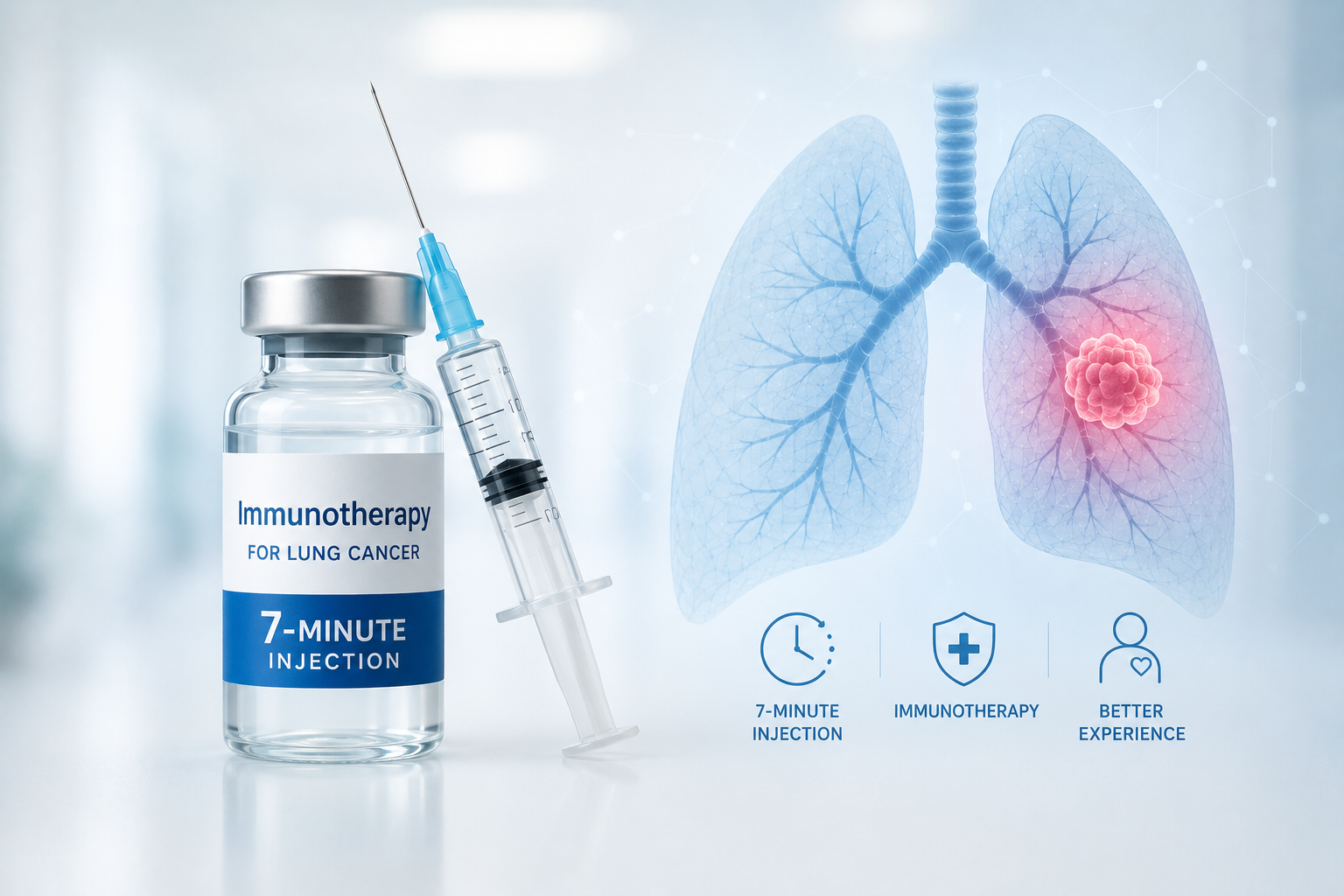
In a major development for cancer treatment in India, Roche Pharma India has launched the country’s first seven-minute injectable immunotherapy for lung cancer, introducing a faster and potentially more convenient treatment option for patients.
The therapy is a subcutaneous version of Tecentriq, one of Roche’s widely used immunotherapy medicines. Unlike traditional intravenous (IV) infusions that can take anywhere between 30 minutes to several hours, the new injectable format can reportedly be administered in just seven minutes.
The launch is being viewed as an important advancement in oncology treatment delivery, especially in a country where rising cancer cases continue to place pressure on healthcare infrastructure, hospitals, and patient care systems.
What Is Immunotherapy?
Immunotherapy is a type of cancer treatment that helps the body’s immune system identify and fight cancer cells more effectively.
Unlike chemotherapy, which directly attacks rapidly dividing cells, immunotherapy works differently.
It strengthens or activates the immune system so it can recognize and target cancer cells more efficiently.
Over the last decade, immunotherapy has become one of the most significant breakthroughs in modern oncology, especially for cancers such as:
- lung cancer
- melanoma
- bladder cancer
- liver cancer
- certain breast cancers
Drugs like Tecentriq are part of a class called immune checkpoint inhibitors, which help remove the “brakes” cancer places on the immune system.
Also read: https://circleofnews.in/pcos-renamed-pmos/
Why the 7-Minute Injection Matters?
One of the biggest challenges in cancer treatment is not just the medicine itself – but the time, logistics, and physical strain involved in repeated hospital visits.
Traditional IV-based immunotherapy often requires:
- prolonged hospital chair time
- infusion monitoring
- extended patient waiting periods
- higher clinical resource allocation
The new subcutaneous injection format significantly reduces administration time. Instead of lengthy infusions, patients can receive the treatment through a quick injection under the skin.
This could potentially improve:
- patient comfort
- treatment efficiency
- hospital workflow management
- clinical capacity utilization
For patients undergoing long-term cancer treatment, shorter therapy sessions can make a meaningful difference to overall quality of life.
Lung Cancer Remains One of India’s Biggest Health Concerns
Lung cancer continues to be among the most commonly diagnosed cancers globally and in India.
Factors contributing to rising cases include:
- tobacco use
- air pollution
- occupational exposure
- environmental risk factors
- genetic predisposition
One of the biggest challenges with lung cancer is that it is often diagnosed at later stages, making treatment more complex.
Advancements in targeted therapy and immunotherapy have improved outcomes for several patients in recent years, but accessibility and treatment infrastructure remain critical concerns.
The introduction of faster treatment formats could help improve treatment efficiency in high-volume oncology centres.
How Subcutaneous Immunotherapy Works
The newly introduced therapy uses a subcutaneous formulation, meaning the medicine is injected directly beneath the skin rather than through intravenous infusion.
This method is increasingly gaining attention globally because it can:
- reduce administration time
- simplify hospital procedures
- lower infusion-related burdens
- improve patient convenience
Subcutaneous delivery formats are already being explored across multiple therapeutic areas beyond oncology.
In cancer care specifically, experts believe such innovations may help improve treatment accessibility while easing pressure on hospital resources.
The Shift Toward Patient-Centric Cancer Care
Modern oncology is increasingly focusing not only on treatment effectiveness but also on patient experience. Cancer treatment can already be physically and emotionally exhausting.
Reducing treatment complexity, hospital waiting times, and procedural burden has therefore become an important focus area globally.
Healthcare innovation today is increasingly moving toward:
- faster treatment administration
- minimally invasive procedures
- personalized medicine
- outpatient-friendly therapies
- better quality-of-life outcomes
The launch of India’s first seven-minute injectable immunotherapy reflects this broader transformation in cancer care delivery.
Why This Matters for Indian Healthcare Infrastructure
India’s healthcare system faces enormous patient volumes, particularly in oncology departments of major hospitals.
Long infusion therapies often require:
- dedicated infusion chairs
- nursing supervision
- extended clinical monitoring
- hospital resource allocation
Faster administration methods could potentially help hospitals:
- optimize patient flow
- reduce treatment bottlenecks
- improve operational efficiency
- accommodate more patients
While the therapy may not immediately transform access across all regions, experts believe it represents an important step toward modernizing oncology care infrastructure.
Innovation in Oncology Is Accelerating Globally
The global cancer treatment landscape is evolving rapidly with breakthroughs in:
- immunotherapy
- precision medicine
- AI-driven diagnostics
- genomic testing
- targeted therapies
Pharmaceutical companies are increasingly focusing on improving not just survival outcomes, but also treatment convenience and accessibility.
The introduction of injectable immunotherapy formats is part of that broader shift.
For India, access to newer oncology technologies is especially important as cancer incidence continues rising and healthcare systems work toward expanding advanced treatment access.
Cost and Accessibility Remain Important Conversations
While the medical innovation is significant, affordability and accessibility remain critical topics in India’s healthcare ecosystem.
Advanced cancer therapies often come with high treatment costs, limiting access for many patients.
As newer therapies enter the Indian market, healthcare experts continue emphasizing the need for:
- wider insurance support
- stronger healthcare infrastructure
- improved affordability pathways
- broader access across tier-2 and tier-3 cities
The success of innovative oncology solutions in India will depend not only on technology but also on how accessible these treatments become over time.
What This Means for the Future of Cancer Treatment?
The launch of India’s first seven-minute injectable immunotherapy represents more than just a faster injection.
It reflects a larger evolution in how cancer treatment is being designed:
- more efficient
- more patient-friendly
- less time-intensive
- technologically advanced
As healthcare systems globally move toward more personalized and efficient care models, innovations like these may gradually become more common across therapeutic areas.
For patients, the hope is simple: effective treatment with less physical, emotional, and logistical burden.
Conclusion
Roche Pharma India launching India’s first seven-minute injectable immunotherapy for lung cancer marks an important milestone in the country’s oncology landscape.
The subcutaneous version of Tecentriq highlights how cancer treatment is evolving toward faster, more patient-centric care models.
While challenges around affordability and accessibility remain, the development signals continued progress in bringing advanced cancer therapies to Indian healthcare systems.
And in oncology, even small improvements in treatment experience can make a meaningful difference in patients’ lives.
