

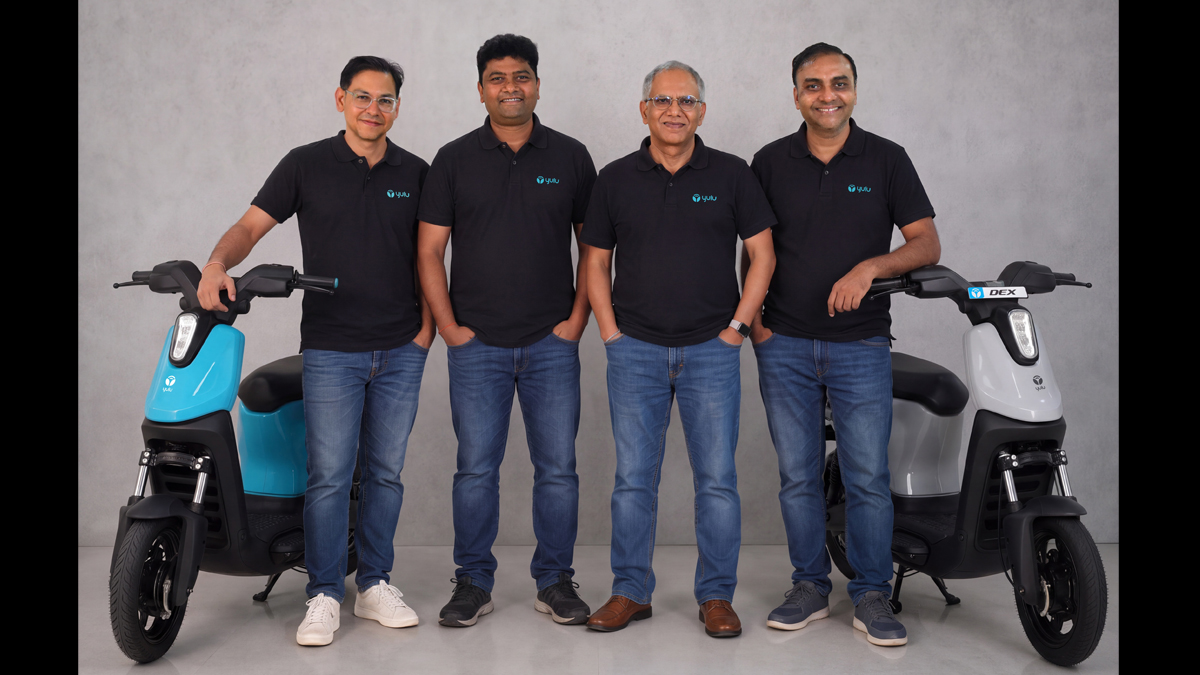
Bengaluru-based electric mobility startup Yulu has raised $93 million in its Series C funding round as it looks to expand its electric vehicle fleet, enter new mobility segments and move closer to a potential public listing.
The latest Yulu funding round comprises $63 million in equity and $30 million in debt, with climate-focused investment firm GEF Capital Partners leading the equity component. The company has not disclosed its valuation or the lenders involved in the debt financing.
The fresh capital comes at an important stage for Yulu. The company is now moving from building its electric mobility business to scaling it significantly, with plans to quadruple its active fleet to 200,000 electric two-wheelers over the next two years.
Yulu Funding: What Will the $93 Million Be Used For?
Yulu plans to deploy the new funding towards expanding its EV fleet, increasing service hubs, strengthening enterprise partnerships and entering additional hyperlocal mobility use cases.
The company currently operates across 12 markets, including four primary metropolitan markets — Bengaluru, Mumbai, Delhi-NCR and Hyderabad — along with eight franchise-operated regional markets. Yulu plans to expand its presence to around 20 cities over the next year.
The company’s current fleet is estimated at around 50,000 electric vehicles, meaning the planned expansion to 200,000 vehicles represents a significant scale-up.
For Yulu, this is not simply about putting more electric vehicles on Indian roads. The company is increasingly positioning itself as an electric mobility-as-a-service platform serving India’s growing last-mile delivery and urban mobility economy.
From Urban Commuting to Quick Commerce
Yulu’s business has evolved considerably since its founding in 2017.
The company initially built its business around shared electric mobility and short-distance urban commuting. However, the shift in consumer behaviour during and after the pandemic forced the company to rethink how its vehicles were being used.
The rapid growth of food delivery and quick commerce created a new opportunity.
Delivery workers needed affordable vehicles that could be operated for long hours without the fuel costs associated with conventional two-wheelers. Yulu began focusing more heavily on this segment and developed vehicles specifically suited for delivery operations.
Today, quick-commerce and food-delivery workers form an important part of Yulu’s customer base.
The company says its fleet supports more than 750,000 doorstep deliveries every day and powers over 15% of quick-commerce deliveries across India’s four largest metropolitan centres.
That gives Yulu an interesting position at the intersection of two rapidly expanding markets: electric mobility and quick commerce.
Yulu Express: A New Electric Scooter for Logistics
One of the most important developments accompanying the funding is Yulu’s expansion into larger electric vehicles.
The company plans to launch Yulu Express, a full-sized, high-payload electric scooter designed for applications including e-commerce logistics, bike taxis and express parcel delivery.
This marks a shift from Yulu’s traditional low-speed electric vehicles.
The company expects a significant portion of its future 200,000-vehicle fleet to comprise these larger vehicles, allowing it to address a wider range of intra-city transportation requirements.
This could also help Yulu reduce its dependence on a single use case and create multiple revenue opportunities from the same broader mobility platform.
Yulu’s Push Towards Profitability
The latest funding round also comes as Yulu’s financial performance shows signs of improvement.
According to the company, its revenue increased sevenfold between FY23 and FY26, while it has maintained positive EBITDA since April 2025.
For FY25, Yulu’s operating revenue nearly doubled to approximately ₹237.4 crore, compared with ₹120 crore in FY24, while its net loss narrowed by around 12% to ₹126 crore.
The company has also indicated that it is targeting monthly profit after tax (PAT) positivity next year, before eventually pursuing a public listing.
CEO and co-founder Amit Gupta told Reuters that the company is now operationally profitable and that its primary funding requirement is to expand its vehicle fleet rather than fund day-to-day operations.
That represents an important change for an asset-heavy electric mobility startup.
Why Yulu’s Business Model Is Interesting?
Electric mobility companies often face a difficult balancing act. Scaling a fleet requires significant upfront capital, while the vehicles need to generate sufficient utilisation to justify that investment.
Yulu’s strategy is to improve utilisation by placing its vehicles in segments where demand is frequent and predictable, particularly last-mile delivery.
The company combines its vehicle fleet with technology, fleet management and energy infrastructure. It also works with Bajaj Auto on vehicle manufacturing and Magna International on battery-swapping infrastructure.
This integrated approach allows Yulu to participate in more than just vehicle rentals.
It is effectively building an infrastructure layer for urban electric mobility.
The Bajaj Auto Connection
Yulu’s relationship with Bajaj Auto has been an important part of its growth story.
The two companies have worked together on vehicle manufacturing, while Bajaj Auto is also an existing investor in Yulu.
However, Bajaj Auto and Magna International did not participate in the latest Series C funding round, according to Reuters.
The latest equity investment was led by GEF Capital Partners, a climate-focused investor that sees shared electric mobility as an increasingly important component of urban infrastructure.
GEF Capital Partner Alipt Sharma said Yulu has demonstrated that sustainable mobility can also develop into a scalable business, pointing to the company’s operational capabilities and market position.
Yulu and India’s Growing EV Delivery Market
The expansion comes as India’s delivery economy continues to grow. Quick commerce, food delivery, e-commerce and hyperlocal services have created a large workforce that depends on two-wheelers for daily earnings.
For these workers, operating costs matter.
Electric vehicles can reduce exposure to petrol prices and, depending on usage and operating conditions, lower running costs. Yulu says its mobility platform can increase gig workers’ net earnings by 30-40% through lower operating costs.
The company also says its fleet helps avoid around two million kilograms of carbon dioxide emissions every month.
This gives the business both an economic and sustainability proposition.
From 50,000 to 200,000 EVs
The scale of Yulu’s next phase is significant.
The company is targeting:
- 200,000 active EVs within two years
- Expansion from 12 markets to around 20 cities
- New electric mobility use cases
- Expansion of service hubs
- Growth in enterprise partnerships
- Launch of Yulu Express
- Greater profitability
- Potential public-market listing in the coming years
The company is therefore attempting to move from being primarily an electric two-wheeler rental company to becoming a broader urban mobility and logistics platform.
What the Yulu Funding Means for India’s Electric Mobility Sector?
The $93 million Yulu Series C round is also significant for India’s wider EV ecosystem.
Electric mobility startups are capital-intensive businesses. Unlike software companies, they need physical vehicles, batteries, charging or swapping infrastructure, maintenance networks and operational teams.
That makes access to growth capital particularly important.
At the same time, investors are becoming more selective. Fleet utilisation, unit economics and the ability to generate sustainable revenue are increasingly important when evaluating EV businesses.
Yulu’s improved revenue, positive EBITDA and focus on commercial mobility indicate a strategy built around these realities.
The company’s latest funding therefore comes at a time when India’s EV market is moving beyond the initial adoption phase and towards commercial-scale deployment.
The Road Ahead for Yulu
Yulu’s next challenge will be execution.
Taking an active fleet from roughly 50,000 vehicles to 200,000 in two years will require significant operational expansion. The company will also need to ensure that its larger fleet maintains strong utilisation and healthy economics.
The launch of Yulu Express could help by opening new categories such as e-commerce logistics, bike taxis and express parcel delivery.
At the same time, the company’s focus on profitability could make its journey towards a potential IPO more credible.
For now, the message from Yulu’s latest fundraise is clear: the company is betting that India’s next phase of urban mobility growth will be electric, shared and increasingly connected to the country’s delivery economy.
With $93 million in fresh funding and a target of 200,000 EVs, Yulu is preparing for its biggest expansion yet.
