

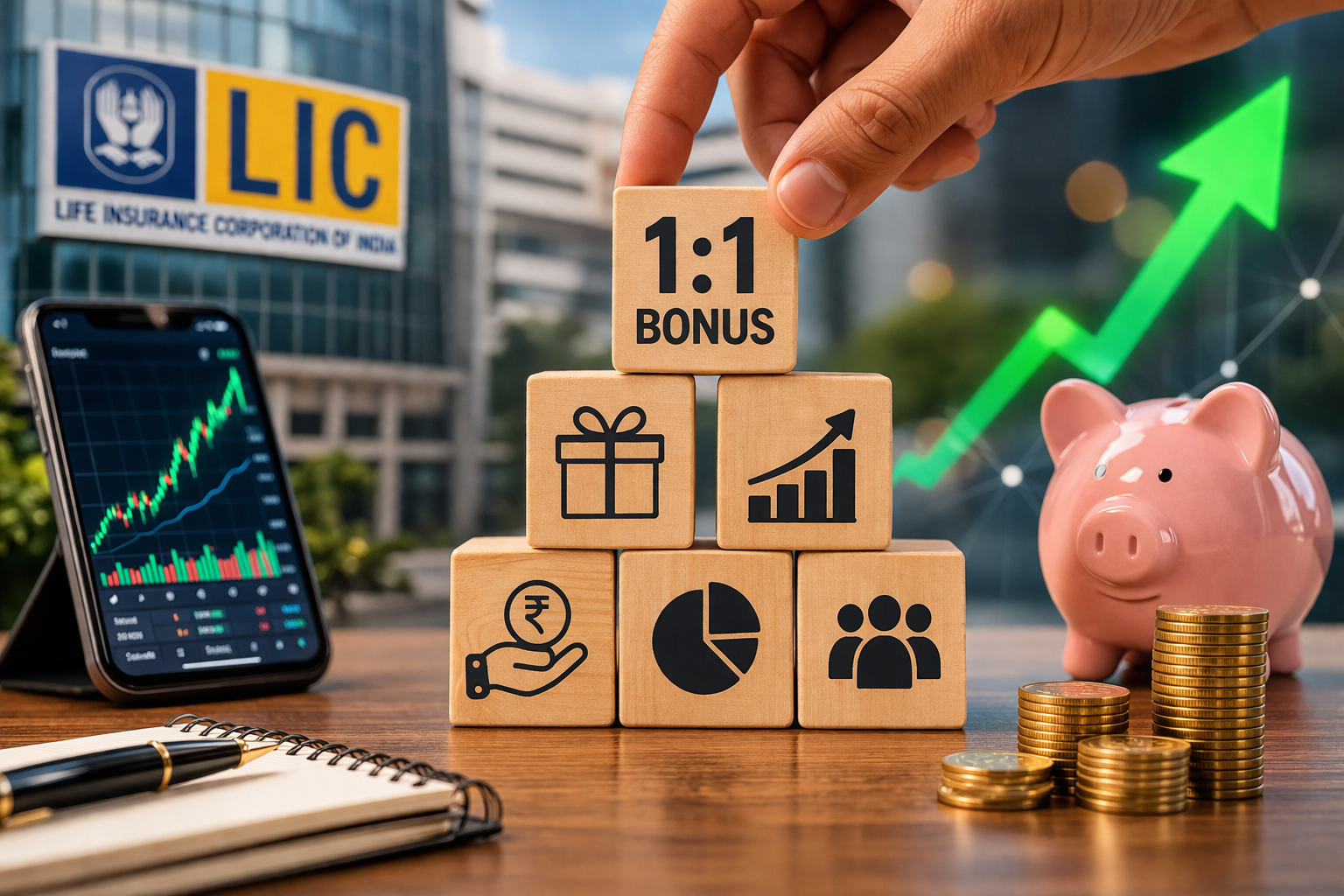
In a major development for India’s stock market and retail investors, Life Insurance Corporation of India has announced its first-ever bonus issue since listing, approving a 1:1 bonus share issue.
This means every eligible shareholder will receive one additional share for every one share already held on the record date. In simple terms, if an investor currently owns 100 LIC shares, they will receive 100 more shares free of cost, taking the total holding to 200 shares.
The move has immediately triggered strong investor interest because this is a landmark corporate action for one of India’s largest and most closely tracked public sector companies. More importantly, many retail investors are asking the same question:
Does this mean my investment doubles?
The short answer is no — at least not immediately.
This article explains everything in detail.
What Exactly Has LIC Announced?
LIC’s board has approved a 1:1 bonus issue of fully paid-up equity shares of ₹10 face value each. This is the company’s first bonus issue since its stock market debut in May 2022.
Under this corporate action:
- 1 existing share = 1 free bonus share
- ratio = 1:1
- bonus shares will be issued from reserves
- record date is yet to be announced
The insurer is capitalising approximately ₹6,325 crore from reserves and surplus as of December 31, 2025, to fund the issue.
What Does a 1:1 Bonus Issue Mean?
This is the most searched part of the story. A 1:1 bonus issue means you receive one extra share for every one share you already own.
Example
If you own:
- 10 shares → you get 10 extra
- 50 shares → you get 50 extra
- 100 shares → you get 100 extra
So the total share count doubles.
However, your total investment value usually remains almost the same immediately after the adjustment because the stock price typically falls proportionately.
Does Your Money Double?
This is where many new investors get confused. No, your wealth does not instantly double. Let’s understand this with an example.
Suppose LIC share price is ₹800.
You own 100 shares.
Before bonus
100 × ₹800 = ₹80,000
After 1:1 bonus, you get 100 extra shares.
Now you own 200 shares.
But the share price may adjust to around ₹400.
After bonus
200 × ₹400 = ₹80,000
So your value remains roughly unchanged initially.
The bonus issue changes quantity, not immediate wealth.
This is one of the most important concepts investors should understand.
Why Do Companies Issue Bonus Shares?
This is where the story becomes interesting. Companies issue bonus shares for multiple reasons.
1. Reward shareholders
It is seen as a shareholder-friendly move.
It signals confidence and long-term commitment to investors.
2. Improve liquidity
A lower post-bonus share price often attracts more retail participation.
For example, if LIC trades near ₹800 and adjusts closer to ₹400, it becomes psychologically more affordable.
3. Broader ownership
More shares in circulation usually improves trading volumes.
4. Signal confidence
Bonus issues often communicate that the company is financially comfortable and has sufficient reserves.
For LIC, this is a major signal.
Why Is This Important for LIC?
This is LIC’s first-ever bonus issue since listing. That alone makes it historically significant. LIC remains one of India’s biggest public sector financial institutions. It is also among the country’s largest institutional investors.
Its assets under management exceed ₹57 lakh crore, making it a giant in India’s insurance and investment ecosystem. A bonus issue from such a large PSU is likely to drive strong retail attention.
What About the Record Date?
As of now, the record date has not yet been announced. This is extremely important. The record date decides who is eligible to receive bonus shares. Only shareholders who own LIC shares as of the record date will receive the bonus.
The company has said it will announce this date separately. Investors will need to buy the stock before the ex-date to become eligible.
Share Capital Before and After Bonus
The scale of this issue is massive.
Before bonus
Paid-up equity capital:
₹6,324.99 crore
Shares:
approximately 632.49 crore shares
After bonus
Paid-up capital doubles to:
₹12,649.99 crore
Shares:
approximately 1,264.99 crore shares
This effectively doubles the number of listed LIC shares.
How Did the Market React?
LIC shares were already in focus before the board meeting. The stock had earlier surged more than 8% after the announcement that the board would consider a bonus issue. On the day of the board approval, the stock closed near ₹804, marginally higher.
This shows strong investor interest and positive sentiment around the corporate action.
Why This Matters for Retail Investors?
For retail investors, bonus issues are often seen positively because:
- more shares are added
- stock becomes more affordable
- liquidity improves
- market sentiment strengthens
However, investors should avoid assuming that this automatically means profits. Real returns depend on future stock performance.
Could This Be Linked to Future Government Stake Sale?
This is a highly discussed angle. The Government of India currently holds around 96.5% stake in LIC.
Several reports suggest that a bonus issue may make future stake dilution or offer-for-sale (OFS) easier. This is important because the government needs to gradually improve public shareholding norms. A broader share base can support this.
Should Investors Buy Before Bonus?
This is one of the most searched questions. The answer depends on investment thesis. Buying solely for bonus shares does not guarantee gains. Because post-bonus, the stock price adjusts.
Instead, investors should evaluate:
- LIC fundamentals
- insurance sector outlook
- valuation
- long-term growth
Bonus alone should not be the only reason to buy.
Final thoughts
LIC’s 1:1 bonus issue is a landmark corporate action and an important moment for India’s public sector market narrative. While it does not instantly double investor wealth, it improves liquidity, broadens participation, and strengthens sentiment around the stock.
For retail investors, the key now is to watch for the record date announcement and understand the price adjustment mechanism clearly. This is less about “free money” and more about capital restructuring and investor reward signaling.

1 Comment
Pingback: Brookfield’s ₹30 Billion Renewable Energy Exit in Rajasthan