

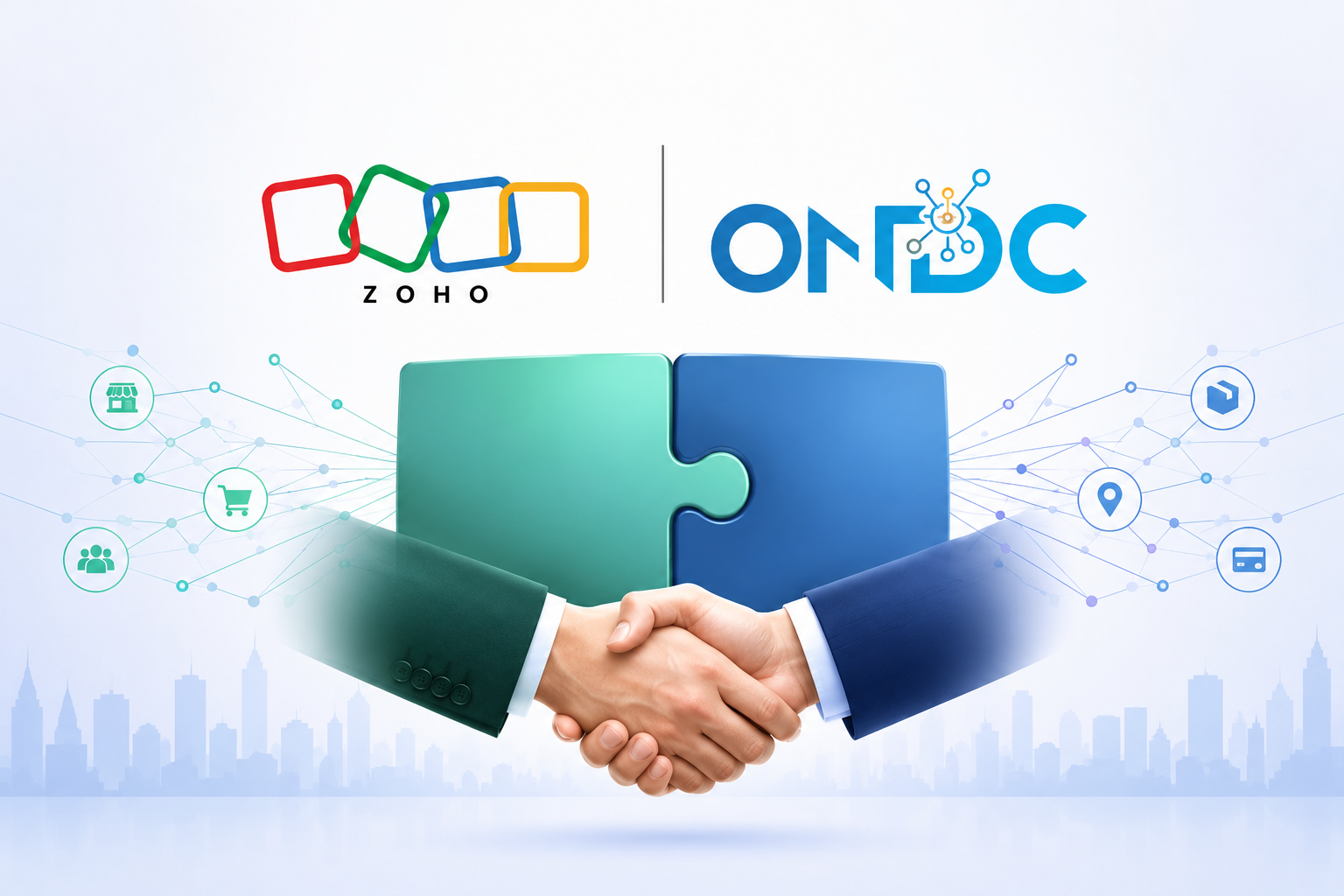
In a significant move for India’s digital commerce ecosystem, Zoho has invested ₹70 crore in the Open Network for Digital Commerce (ONDC), reinforcing growing industry support for India’s push toward open and sovereign digital infrastructure.
The investment is being seen as more than just financial backing. It reflects increasing confidence in ONDC’s long-term vision of creating a more inclusive, interoperable, and decentralized digital commerce ecosystem for Indian businesses – especially MSMEs and smaller merchants.
At a time when digital commerce is largely dominated by closed platform ecosystems, the Zoho-ONDC collaboration highlights a broader shift toward open digital networks designed to give businesses greater independence and accessibility.
What Is ONDC and Why Does It Matter?
The Open Network for Digital Commerce (ONDC) was launched by the Government of India as an initiative aimed at democratizing digital commerce.
Unlike traditional e-commerce platforms that operate within closed ecosystems, ONDC functions as an open network where buyers and sellers can transact across interoperable platforms.
In simpler terms: ONDC aims to reduce platform dependency.
The network is designed to allow businesses — especially small and medium enterprises — to participate in digital commerce without being locked into one dominant marketplace.
This model could potentially reshape how digital commerce functions in India over the long term.
Why Zoho’s Investment Is Important?
Zoho has built a strong reputation as one of India’s most successful global SaaS companies while consistently advocating for:
- digital self-reliance
- privacy-focused technology
- sustainable business models
- independent technology ecosystems
Its decision to invest in ONDC aligns closely with those broader principles.
The ₹70 crore investment is expected to support:
- ONDC’s infrastructure development
- ecosystem growth
- merchant enablement
- MSME onboarding
- technology scalability
The partnership also signals growing corporate support for India’s sovereign digital infrastructure ambitions.
Also read: https://circleofnews.in/aspez-astro-offshore-partners-with-oceaneering-international/
Supporting MSMEs Remains a Major Focus
One of ONDC’s biggest goals has always been enabling greater digital participation for MSMEs.
India’s small businesses often face challenges such as:
- high platform dependency
- visibility issues
- commission-heavy marketplaces
- limited digital infrastructure access
ONDC’s open-network approach attempts to reduce some of these barriers by allowing sellers to participate across interoperable commerce systems.
Zoho’s investment is particularly relevant because the company itself has long focused on serving small and medium businesses through software and enterprise solutions.
The alignment between ONDC’s MSME-first approach and Zoho’s long-standing business philosophy makes the partnership strategically significant.
India’s Push for Sovereign Digital Infrastructure
The phrase “sovereign tech infrastructure” has increasingly become part of India’s broader digital policy conversation.
The idea centers around building critical digital systems that are:
- open
- locally governed
- interoperable
- less dependent on foreign-controlled ecosystems
ONDC is often viewed as part of that larger infrastructure strategy alongside initiatives involving:
- digital identity systems
- digital payments
- public digital infrastructure
- open network protocols
Zoho’s investment reinforces the idea that Indian technology companies are beginning to play a more active role in supporting these ecosystem-level initiatives.
The Bigger Shift Away From Closed Platforms
Globally, digital commerce has traditionally been dominated by platform-centric ecosystems where one company controls:
- discovery
- transactions
- logistics visibility
- customer access
ONDC proposes a different model.
Instead of centralization, it focuses on interoperability. That means businesses could theoretically interact across multiple buyer and seller applications while remaining part of the same network.
While the model is still evolving, many industry experts believe it could significantly influence the future structure of Indian digital commerce.
Zoho’s Larger Philosophy Around Technology
What makes the investment particularly interesting is how closely it aligns with Zoho’s long-standing philosophy around technology independence.
The company has consistently emphasized:
- sustainable growth over aggressive funding
- product ownership
- privacy-first systems
- localized infrastructure
- long-term ecosystem building
Unlike many fast-scaling startups, Zoho has historically maintained an independent and profitable growth model. Its backing of ONDC therefore carries symbolic significance beyond the monetary value itself.
It suggests confidence in India’s ability to build large-scale open digital ecosystems.
ONDC’s Expansion Across Sectors
Initially associated mainly with e-commerce, ONDC has gradually expanded into multiple categories including:
- food delivery
- mobility
- retail
- logistics
- hyperlocal commerce
- B2B trade
Several startups, enterprises, and service providers have already integrated with the network.
The long-term success of ONDC will likely depend on:
- merchant adoption
- user experience
- interoperability efficiency
- ecosystem participation
- network scalability
Investments from established technology players like Zoho may help strengthen those areas over time.
Why This Matters for India’s Startup Ecosystem?
The ONDC model could have major implications for startups and emerging digital businesses.
For years, startups entering digital commerce often had to compete within ecosystems controlled by large centralized platforms.
An open-network structure may potentially create:
- lower entry barriers
- more competitive flexibility
- improved discoverability
- diversified digital participation
While ONDC is still developing, its success could influence how future Indian digital platforms are designed.
Challenges Still Remain
Despite growing optimism, ONDC still faces several operational and adoption challenges.
These include:
- merchant education
- user awareness
- platform integration complexity
- consistent customer experience
- logistics coordination
- network scalability
Open digital ecosystems are significantly more complex to manage than centralized platforms.
However, supporters argue that the long-term benefits of openness and interoperability may outweigh those challenges.
India’s Digital Public Infrastructure Story Is Expanding
Over the last few years, India has increasingly positioned itself as a leader in digital public infrastructure innovation.
Systems like:
- UPI
- Aadhaar
- DigiLocker
- ONDC
reflect an attempt to build population-scale digital ecosystems with open-access principles.
The broader vision is not just technological expansion, but digital inclusion at scale.
Zoho’s investment in ONDC can therefore also be viewed as part of India’s larger digital infrastructure evolution.
Conclusion
Zoho investing ₹70 crore into ONDC marks an important moment for India’s evolving digital commerce ecosystem.
The partnership goes beyond funding.
It reflects growing confidence in:
- open digital networks
- sovereign technology infrastructure
- MSME-focused digital growth
- interoperable commerce systems
As India continues building large-scale digital ecosystems, collaborations like this could play an important role in shaping the future of commerce, technology, and digital participation in the country.
