

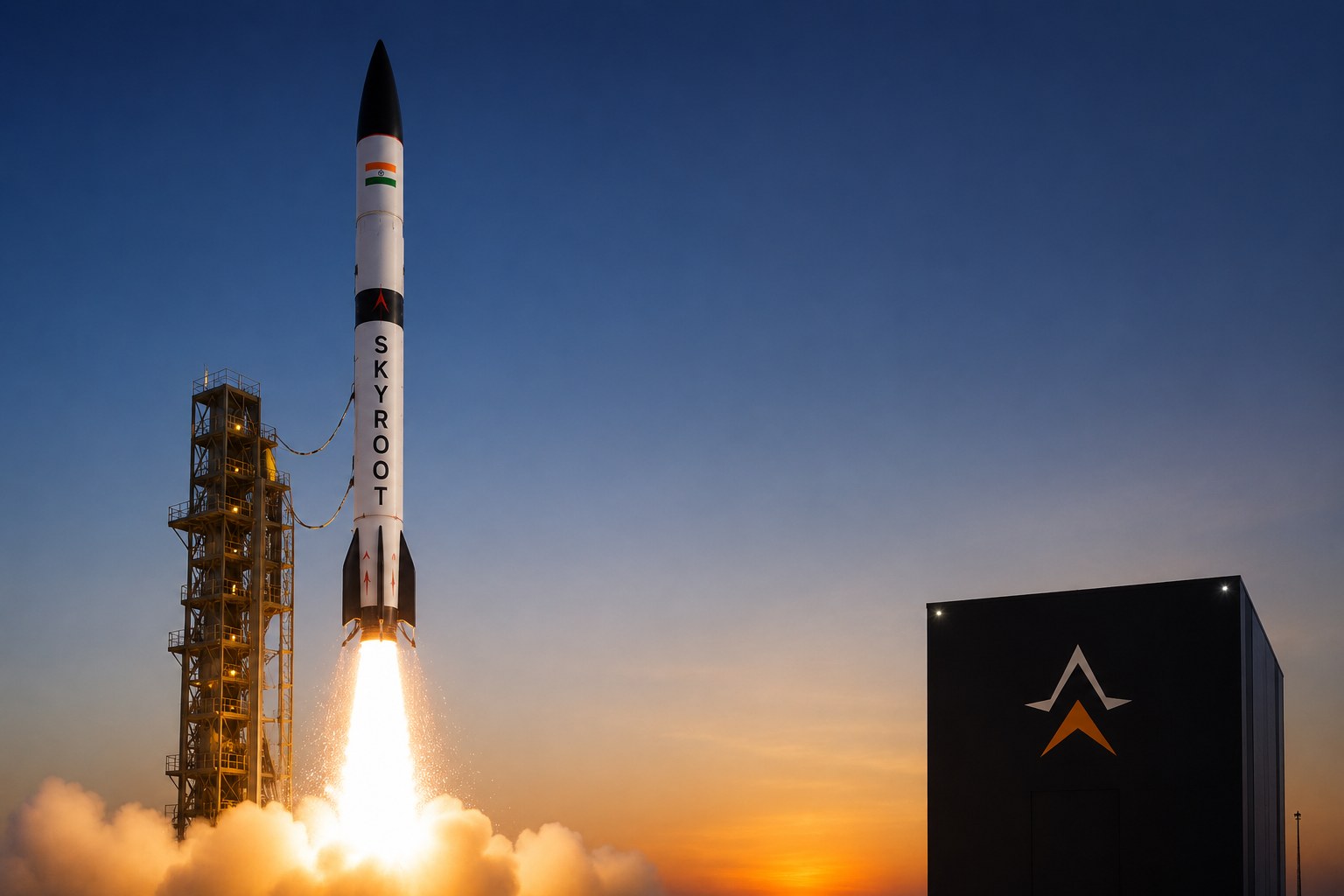
India’s private space sector has entered a defining new chapter.
Skyroot Aerospace has officially become India’s first space-tech unicorn after raising $60 million in a major funding round backed by global investors including GIC, BlackRock-managed funds, and Ram Shriram’s Sherpalo Ventures.
The milestone comes at a crucial moment for the Hyderabad-based startup, which is preparing for the launch of its much-anticipated Vikram-1 orbital rocket.
But this story is bigger than a valuation milestone.
Skyroot’s rise reflects:
- The rapid evolution of India’s private space ecosystem
- Growing global confidence in Indian deep-tech startups
- The commercialization of space beyond government agencies
- A new era of launch infrastructure and satellite economies
And perhaps most importantly, it signals that India’s startup ecosystem is beginning to compete in one of the world’s most complex and capital-intensive industries: space technology.
The Moment That Changed India’s Space-Tech Narrative
For decades, India’s space ambitions were almost entirely represented by the Indian Space Research Organisation (ISRO).
ISRO built global respect through:
- Cost-efficient missions
- Satellite launches
- Lunar and Mars exploration
- Scientific achievements on limited budgets
But private participation remained limited for years. That began to change after India opened its space sector to private players and startups. Suddenly, a new generation of companies emerged, focused on:
- Launch vehicles
- Satellite manufacturing
- Earth observation
- Space infrastructure
- Data services
Among them, Skyroot quickly became one of the most closely watched names.
Also read: https://circleofnews.in/pronto-raises-20-million/
What Exactly Does Skyroot Aerospace Do?
Skyroot Aerospace is building launch vehicles designed to make satellite deployment faster, more affordable, and more flexible. Its core focus is orbital launch services.
In simpler terms:
The company builds rockets that can carry satellites into space.
This matters because the global satellite market is expanding rapidly.
The rise of:
- Communication satellites
- Earth observation systems
- Climate-monitoring satellites
- Defence and surveillance technologies
- Commercial data infrastructure
…has dramatically increased demand for reliable launch services.
Space is no longer just about exploration. It’s becoming infrastructure.
Why the Vikram Series Matters?
Skyroot’s launch vehicles are named after Vikram Sarabhai, widely regarded as the father of India’s space program.
The company’s earlier achievement, Vikram-S, made headlines as India’s first privately developed rocket to reach space.
Now attention is focused on Vikram-1, Skyroot’s upcoming orbital launch vehicle.
Unlike suborbital missions, orbital launches are far more technically demanding.
They require:
- Precise propulsion systems
- Complex stage separation
- Navigation accuracy
- Payload deployment capability
Successfully launching Vikram-1 would represent a major milestone not just for the company, but for India’s private launch capabilities overall.
Why Investors Are Suddenly Interested in Space-Tech?
Space-tech was once considered too expensive, too risky, and too slow-moving for mainstream venture capital.
That perception is changing globally.
Investors increasingly view space infrastructure as a long-term growth sector because modern economies are becoming deeply dependent on satellite systems.
Today, satellites support:
- GPS navigation
- Weather forecasting
- Telecommunications
- Internet connectivity
- Defence systems
- Agricultural monitoring
- Financial infrastructure
As the number of satellites increases, demand for launch services rises alongside it.
This creates opportunities for companies like Skyroot.
The Significance of the $60 Million Funding Round
Skyroot’s latest funding round is important for several reasons.
1. Unicorn Status Changes Perception
Crossing the billion-dollar valuation mark carries symbolic importance.
It signals:
- Investor confidence
- Market validation
- Scalability potential
More importantly, it changes how global markets view India’s space-tech ecosystem.
India is no longer seen only as a government-led space nation.
It is increasingly viewed as a potential private-sector innovation hub.
2. Deep-Tech Funding Is Growing
Unlike many internet startups, space-tech companies require:
- Heavy engineering
- Long development cycles
- High capital investment
- Advanced research capabilities
That makes funding difficult.
The fact that global institutional investors are now backing Indian space-tech startups suggests growing confidence in the sector’s maturity.
3. Timing Ahead of Vikram-1 Launch
The funding arrives at a strategically important moment.
Building rockets is extremely capital intensive.
Funding supports:
- Manufacturing
- Testing infrastructure
- Research and development
- Launch preparation
- Talent acquisition
The fresh capital gives Skyroot greater operational strength ahead of the Vikram-1 mission.
India’s Space Economy Is Expanding Fast
India’s space economy is expected to grow significantly over the coming decade.
Several factors are driving this growth.
Policy Liberalization
India’s decision to open the space sector to private participation changed the ecosystem dramatically.
This allowed startups to:
- Build rockets
- Access testing facilities
- Partner with ISRO
- Enter commercial launch markets
Without these reforms, companies like Skyroot would have struggled to scale.
Lower Cost Engineering
India’s engineering ecosystem offers:
- Cost efficiency
- Strong technical talent
- Manufacturing capabilities
This creates a major competitive advantage in the global launch market.
Rising Global Satellite Demand
The explosion of satellite applications is increasing launch frequency worldwide.
This includes:
- Commercial internet constellations
- Climate monitoring systems
- National security infrastructure
- Space-based data services
More satellites require more launches.
Space-Tech Is Becoming Infrastructure, Not Experimentation
One of the biggest shifts happening globally is conceptual. Space is no longer viewed purely as science. It is increasingly treated as infrastructure. That changes everything.
Launch systems now support:
- Internet economies
- Defence systems
- Logistics
- Climate intelligence
- Financial services
- AI-driven Earth observation
This infrastructure transition is creating long-term business opportunities for launch providers.
Why Building Rockets Is Exceptionally Difficult?
Rocket companies operate in one of the hardest engineering environments imaginable.
Challenges include:
- Extreme temperatures
- Precision propulsion
- Safety requirements
- Aerodynamic pressures
- Navigation systems
- Regulatory compliance
Failure rates in aerospace are historically high because even tiny errors can cause catastrophic outcomes.
That’s why successful rocket development attracts significant investor attention. The barriers to entry are enormous.
The Global Context: India vs International Launch Players
Globally, the commercial space race has been dominated by companies such as:
- SpaceX
- Rocket Lab
- Blue Origin
India’s ecosystem is still relatively young by comparison.
However, Indian startups may benefit from:
- Lower operating costs
- Government support
- Expanding engineering talent
- Growing investor interest
The market opportunity is large enough for multiple regional players.
The Rise of India’s Deep-Tech Ecosystem
Skyroot’s rise also reflects a broader evolution in Indian startups.
For years, Indian venture capital focused heavily on:
- E-commerce
- Food delivery
- Fintech
- Consumer internet
Now investor attention is gradually expanding toward:
- Aerospace
- Robotics
- AI infrastructure
- Semiconductor systems
- Climate technology
This shift matters because deep-tech ecosystems often create long-term technological capability for countries.
Why This Matters Beyond Startups
The growth of India’s space-tech sector has implications beyond venture funding.
It affects:
- National capability
- Strategic independence
- High-skill employment
- Manufacturing ecosystems
- Research infrastructure
Strong private aerospace ecosystems often generate spillover effects across industries.
Historically, space innovation has contributed to advancements in:
- Materials science
- Telecommunications
- Navigation systems
- Computing
- Defence technologies
The Risks Still Exist
Despite the excitement, space-tech remains high-risk.
Some major challenges include:
- Extremely high capital requirements
- Long profitability timelines
- Launch risks
- Regulatory complexity
- Intense global competition
Not every space startup will succeed. Even globally, many space ventures struggle with sustainability and commercialization. Execution matters enormously.
What Happens Next for Skyroot?
The next major milestone is clear:
Vikram-1.
If successful, it could:
- Validate Skyroot’s technology
- Strengthen customer confidence
- Increase commercial launch demand
- Attract further global investment
A successful orbital launch would also elevate India’s reputation in commercial launch markets.
The Psychological Shift in India’s Startup Ecosystem
Perhaps the most important aspect of Skyroot’s unicorn milestone is psychological.
For years, India’s startup identity centered around:
- Consumer apps
- Marketplace businesses
- Service platforms
Now, Indian founders are increasingly entering industries once considered impossible:
- Rocket engineering
- Semiconductor design
- Advanced AI systems
- Space infrastructure
That shift changes how India is perceived globally. And it changes what future founders believe is possible.
Conclusion
Skyroot Aerospace becoming India’s first space-tech unicorn is not just a funding story.
It is a signal that India’s startup ecosystem is entering a deeper technological era. The company’s $60 million funding round, backed by major global investors, reflects rising confidence in India’s ability to build advanced aerospace infrastructure at scale.
But the real test lies ahead.
If Skyroot successfully executes the Vikram-1 launch and scales commercially, it could become one of the defining companies of India’s emerging deep-tech economy.
And more broadly, it may mark the beginning of a future where India is not only participating in the global space economy – but helping shape it.
