

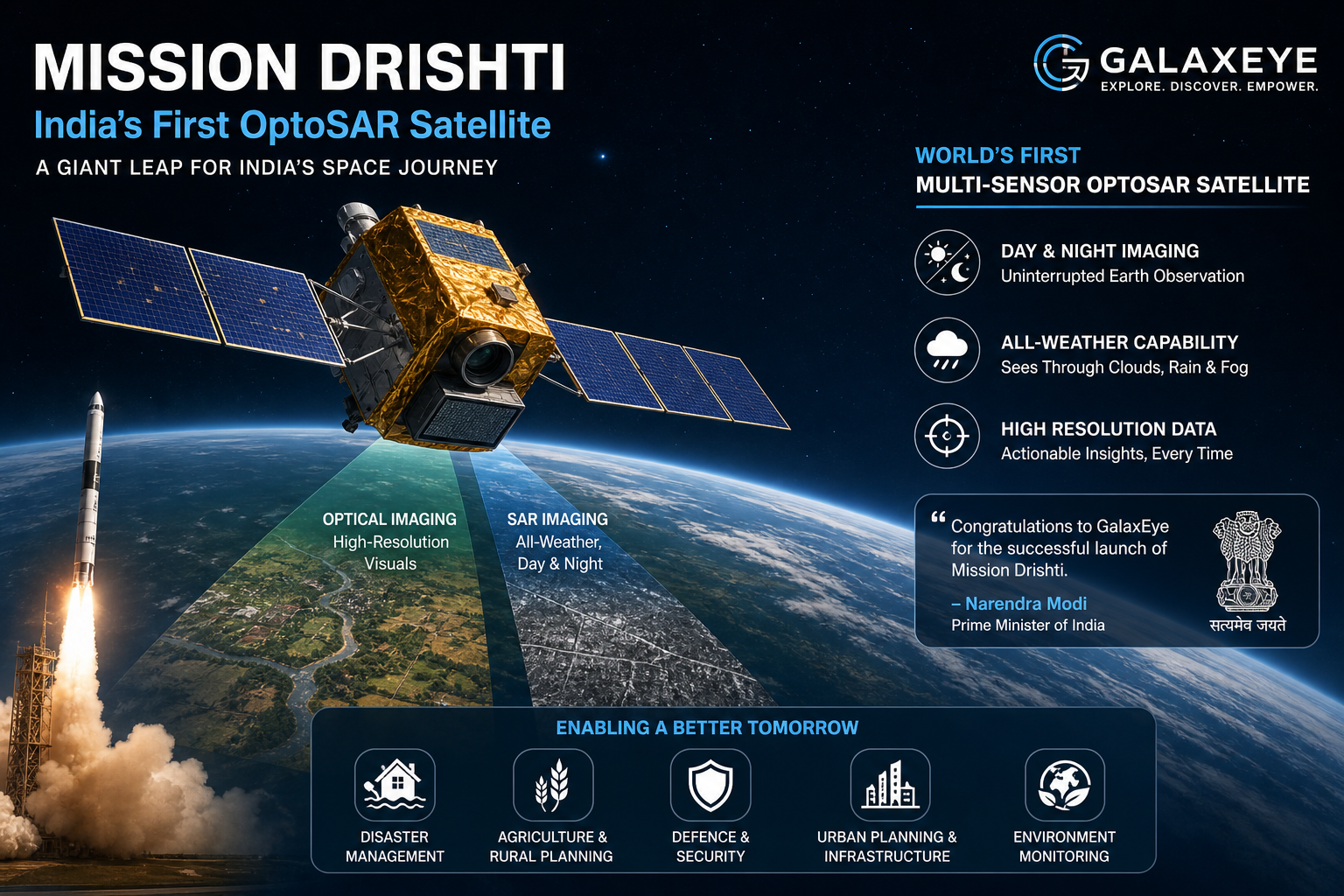
India’s private space sector has taken a significant leap forward with the successful launch of Mission Drishti, an advanced Earth observation satellite developed by Bengaluru-based startup GalaxEye. The mission marks a major milestone not just for the company, but for India’s growing role in next-generation space technology.
Touted as the world’s first multi-sensor OptoSAR satellite, Drishti combines optical and Synthetic Aperture Radar (SAR) imaging into a single platform – unlocking new possibilities for real-time, all-weather Earth observation.
What Is Mission Drishti?
Mission Drishti is designed to overcome one of the biggest limitations in satellite imaging: visibility constraints caused by weather, lighting, and environmental conditions.
Traditional satellites rely on either:
- Optical imaging, which provides high-resolution visuals but depends on daylight and clear skies
- Radar imaging (SAR), which works through clouds and at night but lacks visual clarity
Drishti merges both technologies into a unified system, creating what is known as OptoSAR capability.
Why This Matters?
This integration allows the satellite to:
- Capture images day and night
- See through cloud cover, fog, and rain
- Deliver high-resolution, actionable data
In simple terms, it ensures continuous, reliable observation of Earth, regardless of external conditions.
A Breakthrough for India’s Space Ecosystem
The launch of Drishti represents a turning point in India’s private space journey. While the country has long been recognized for its government-led space missions through Indian Space Research Organisation, startups like GalaxEye are now pushing the boundaries of innovation.
Mission Drishti is being recognized as:
- India’s largest privately developed Earth observation satellite
- A demonstration of deep-tech capabilities within Indian startups
- A signal of India’s transition toward commercial and strategic space leadership
Endorsement from National Leadership
The mission has received strong recognition from Prime Minister Narendra Modi, who congratulated the GalaxEye team on the successful launch.
In his message, the Prime Minister highlighted how such innovations:
- Strengthen India’s position in the global space economy
- Encourage startup-led technological breakthroughs
- Contribute to national development through advanced data capabilities
This endorsement underscores the growing importance of private players in India’s strategic sectors.
Real-World Applications of Drishti
The true power of Mission Drishti lies in its wide-ranging applications across industries and governance.
1. Disaster Management
With its ability to capture images in all conditions, Drishti can play a critical role in:
- Flood monitoring
- Cyclone tracking
- Landslide detection
Real-time data can help authorities respond faster and more effectively during emergencies.
2. Agriculture and Rural Planning
Farmers and policymakers can benefit from:
- Crop health monitoring
- Soil moisture analysis
- Precision agriculture insights
This can improve productivity and support data-driven decision-making in rural India.
3. Defence and Security
The all-weather imaging capability makes Drishti highly valuable for:
- Border surveillance
- Strategic monitoring
- Intelligence gathering
Continuous visibility ensures enhanced national security readiness.
4. Urban Development and Infrastructure
Urban planners can leverage satellite data for:
- Mapping and zoning
- Infrastructure tracking
- Smart city development
Accurate and frequent imaging enables better planning and execution.
What Makes OptoSAR a Game-Changer?
The concept of OptoSAR is what sets Mission Drishti apart globally.
Key Advantages:
- Seamless data fusion: Combines visual clarity with radar precision
- Higher reliability: Works regardless of environmental limitations
- Enhanced analytics: Provides richer datasets for AI-driven insights
This innovation positions GalaxEye among a select group of global pioneers in advanced Earth observation technology.
India’s Growing Private Space Momentum
Mission Drishti is part of a larger trend—the rapid rise of India’s private space ecosystem.
In recent years:
- Policy reforms have opened the sector to startups
- Investment in space-tech has increased significantly
- Collaboration between government and private players has strengthened
Companies like GalaxEye are now contributing to:
- Innovation in satellite technology
- Commercialization of space data
- Global competitiveness in space solutions
The Road Ahead for GalaxEye
With the successful deployment of Drishti, GalaxEye is expected to:
- Expand its satellite constellation
- Enhance data analytics capabilities
- Serve global markets with advanced Earth observation services
The company’s long-term vision includes building a real-time, high-frequency Earth observation network powered by cutting-edge AI and satellite technology.
A Defining Moment for India’s Space Story
Mission Drishti is more than just a satellite launch—it represents a shift in how India approaches space innovation.
It highlights:
- The emergence of startups as key contributors
- The fusion of advanced technologies like AI and satellite imaging
- The potential for India to lead in next-generation space solutions
As the boundaries between public and private space efforts continue to blur, initiatives like Drishti are setting the stage for a more dynamic and globally competitive ecosystem.
Conclusion
The launch of Mission Drishti by GalaxEye marks a defining milestone in India’s space journey. By introducing the world’s first OptoSAR satellite, the company has not only solved critical limitations in Earth observation but also demonstrated the immense potential of India’s private space sector.
With strong backing from leadership, cutting-edge technology, and real-world applications across industries, Drishti signals a future where India is not just participating in the global space race – but actively shaping it.
