

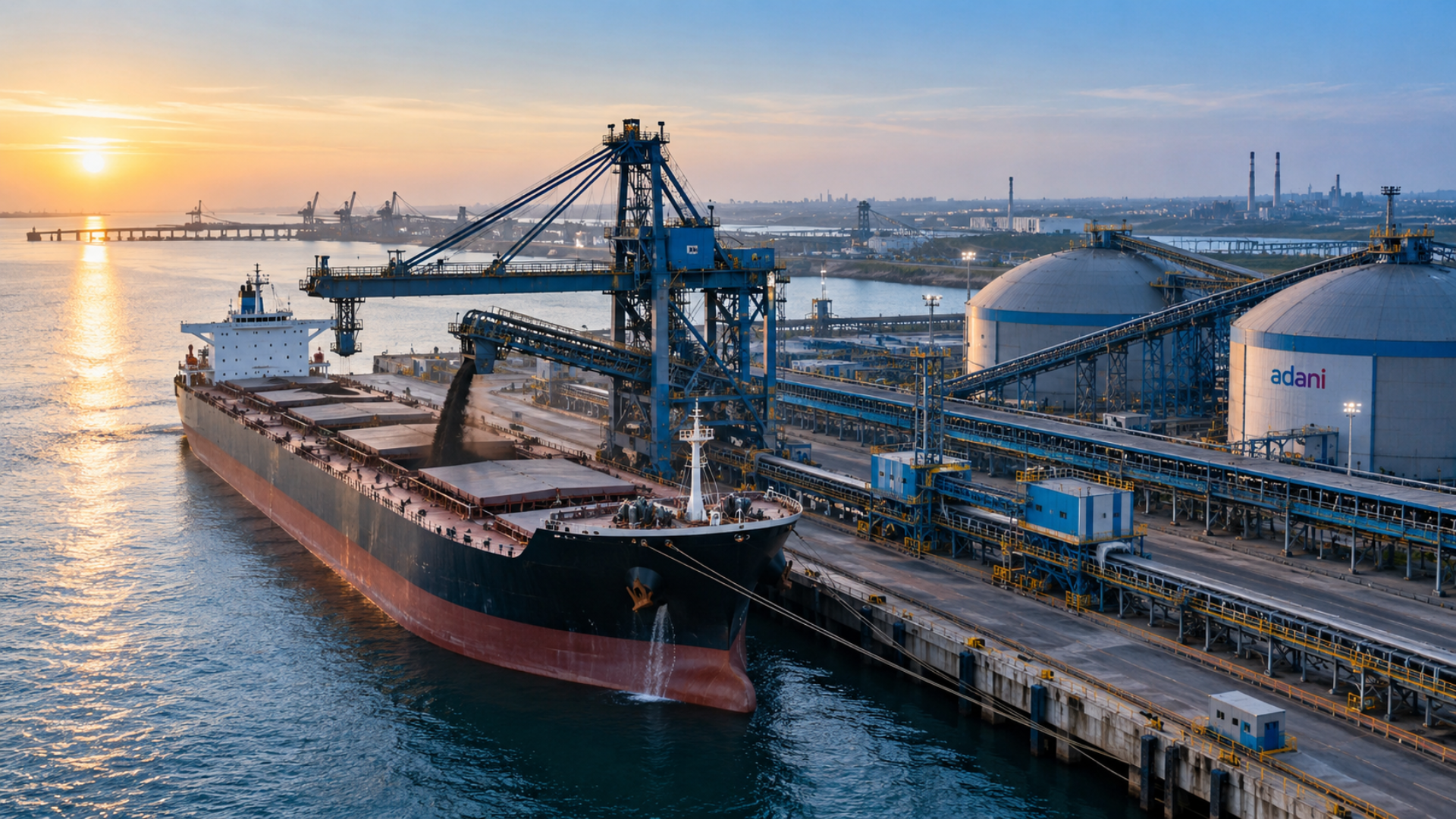
Adani Ports and Special Economic Zone Limited (APSEZ) has won the bid to develop and operate two dry bulk berths at Paradip Port in Odisha. The project will add 18 million metric tonnes (MMT) of mechanised dry bulk handling capacity to the company’s port network.
APSEZ has received the Letter of Award (LoA) for the CQ-I and CQ-II berths. The company will operate the project under a 30-year concession through the public-private partnership model.
With this addition, APSEZ’s total port capacity will rise from 653 MMTPA to 671 MMTPA. The project also supports its stated goal of reaching 1 billion tonnes of cargo throughput by 2030.
APSEZ Paradip Port Project Expands Dry Bulk Capacity
APSEZ will build the new facilities with mechanised cargo handling systems, deep-draft berths and large-scale storage infrastructure. These facilities will support the movement of coal, limestone and other dry bulk commodities.
Paradip is India’s second-largest major port. It also serves as an important cargo gateway for eastern India’s industrial and mineral-producing regions.
The terminal sits near major steel plants and manufacturing clusters. Therefore, the project can strengthen APSEZ’s access to cargo originating from eastern and central India.
Paradip Berths Strengthen APSEZ’s East Coast Presence
The Paradip concession expands APSEZ’s East Coast presence. The company already operates ports at Haldia, Dhamra, Gopalpur and Gangavaram. Together, these ports have a capacity of 140 MMT.
Ashwani Gupta, Whole-time Director and CEO of APSEZ, said the project will expand the company’s reach in a key industrial and mineral-rich hinterland.
“With Paradip, APSEZ’s network grows to 16 ports and terminals across India’s 11,000-km coastline,” Gupta said. He added that the company will use its wider network to offer integrated port, logistics and marine services.
Also Read: Kinetic Upgrades DX+ Electric Scooter With 3.1 kWh Battery, 132 km Certified Range
Paradip Port Berth Win Supports Industrial Cargo Growth
East Coast ports are witnessing higher cargo utilisation as industrial demand grows. In addition, expansion in the steel sector and the policy focus on domestic coal are expected to increase dry bulk cargo movement.
APSEZ stated that the new berths can help ease capacity constraints in the region. The facilities will also support cargo requirements across industrial and manufacturing clusters.
APSEZ operates ports and terminals on India’s west, south and east coasts. Its logistics network includes rail services, multi-modal logistics parks, warehouses, road transport and marine operations.
The company also operates four international ports across Australia, Colombo, Israel and Tanzania. According to APSEZ, it currently handles around 27% of India’s total port volumes.
The APSEZ Paradip Port project adds a strategic dry bulk asset to the company’s network. As a result, it strengthens APSEZ’s ability to serve cargo demand from eastern and central India.
